
Understanding Electromechanical Relays: Working Principles, Types, and Future Innovations

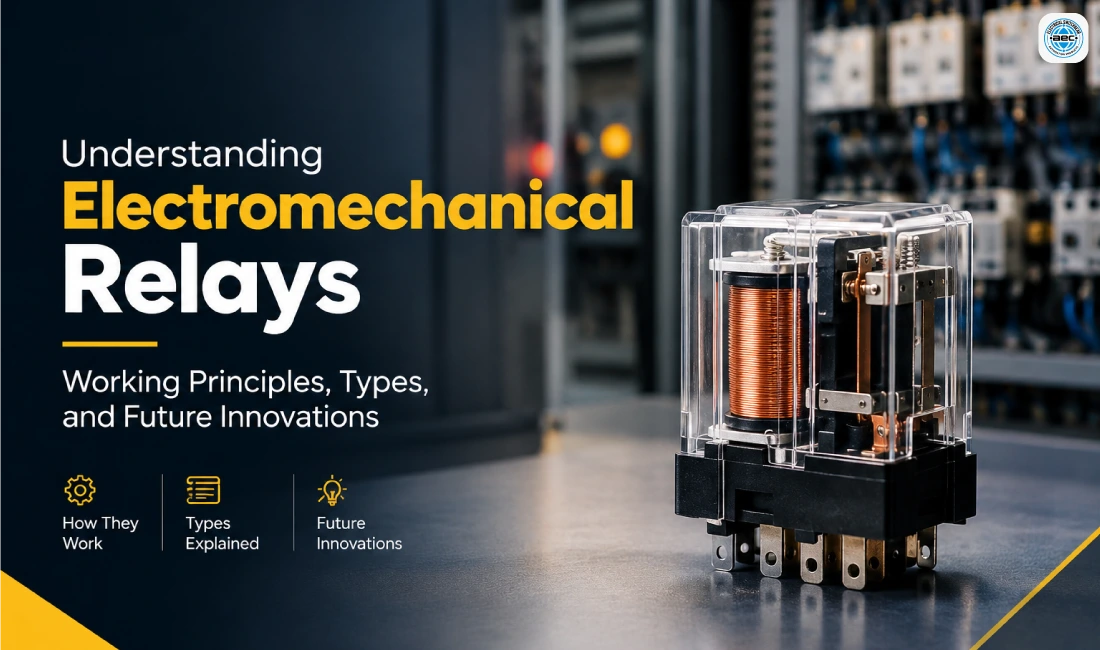
Electrical and electronic systems often need a reliable way to control one circuit using another circuit. This is where Electromechanical Relays become important. They are widely used in industrial control panels, automation equipment, motor control systems, protection circuits, machinery, appliances, and many other electrical applications. Unlike simple switches operated manually, a relay allows an electrical signal to control another circuit automatically. Electromechanical Relays use an electromagnetic mechanism to operate physical contacts, making them useful when isolation between control and load circuits is required. Their straightforward construction, dependable switching operation, and wide range of voltage and current ratings have kept them relevant even as modern automation technologies continue to develop.
What Are Electromechanical Relays?
Electromechanical Relays are electrically operated switching devices that use electromagnetic force to open or close electrical contacts. A typical relay contains a coil, magnetic core, armature, spring mechanism, and one or more electrical contacts. When voltage is applied to the coil, current produces a magnetic field that attracts the armature. This mechanical movement changes the position of the contacts and allows another electrical circuit to be switched. When the coil is de-energized, the magnetic force disappears and the spring generally returns the armature to its original position. This simple process allows a low-power control signal to operate a separate circuit carrying a different voltage or current. Because the control and load sides can remain electrically separated, Electromechanical Relays are particularly useful in industrial electrical control systems where isolation, dependable switching, and straightforward circuit operation are important.The basic construction of Electromechanical Relays can vary depending on their application, but the operating concept remains similar. The relay coil creates the magnetic field, the iron core strengthens that magnetic field, and the armature moves when the coil is energized. The contacts attached to the mechanism then change their electrical state. Relay contacts may be normally open (NO), normally closed (NC), or arranged as changeover contacts. This gives engineers flexibility when designing control circuits. For example, a normally open contact can remain disconnected until the relay receives a control signal, while a normally closed contact can open when the relay is energized. This makes electromechanical switching suitable for applications ranging from basic machine control to more complex automation panels.
How Do Electromechanical Relays Work?
The working principle of Electromechanical Relays is based on electromagnetic attraction and mechanical movement. When the input voltage reaches the relay coil, current flows through the coil winding and generates a magnetic field around the core. The magnetic field attracts the movable armature toward the core, causing the attached contacts to change position. Depending on the relay design, normally open contacts may close, normally closed contacts may open, or a common contact may transfer between two terminals. Once the input signal is removed, the magnetic field decreases and the return spring moves the armature back to its original position. The contacts consequently return to their normal state. This sequence happens quickly enough for many control applications while still providing the physical switching action that defines Electromechanical Relays.The operation can be understood through four basic stages: input, magnetism, mechanical movement, and switching. First, an electrical control signal is applied to the coil. Second, the energized coil produces a magnetic field. Third, the magnetic force moves the armature. Finally, the movement changes the contact arrangement and controls the connected load circuit. The relay therefore acts as an interface between a control signal and an electrical load. In an industrial control panel, for example, a small control signal from a push button, sensor, timer, or PLC output can energize a relay coil. The relay contacts can then control another device or circuit according to its electrical rating and configuration.One of the major advantages of Electromechanical Relays is the separation between the coil circuit and contact circuit. This electrical isolation can help protect sensitive control equipment from the higher voltage or current present on the load side, provided the relay is correctly selected and installed. Relays can also provide multiple contact arrangements, allowing one input signal to perform different switching functions. However, because the contacts and armature physically move, mechanical relays have a finite operating life and may produce contact wear over repeated switching cycles. Engineers therefore need to consider factors such as switching frequency, load type, contact rating, coil voltage, electrical endurance, mechanical endurance, and environmental conditions when selecting a relay.
Types of Electromechanical Relays
There are several types of Electromechanical Relays, and they are generally differentiated according to their contact arrangement, construction, switching function, or intended application. One of the simplest classifications is based on contact configuration. Normally Open (NO) relays keep their output contacts open when the coil is not energized and close them when the relay operates. Normally Closed (NC) relays work in the opposite way, keeping the contacts closed in their normal state and opening them when the coil is energized. Changeover relays provide a common terminal that switches between normally closed and normally open contacts. These configurations allow the same basic electromagnetic principle to be adapted for different electrical control requirements.Another useful category is the latching relay, which can maintain its contact position after the initial switching command without requiring continuous coil energization, depending on its design. Latching arrangements can be useful where reducing continuous coil power consumption is important. Power relays are designed for switching comparatively higher loads than many signal relays, while interface relays are commonly used between control systems such as PLC outputs and field devices. There are also relays designed for specific applications, including automotive systems, motor control, industrial automation, instrumentation, and protection circuits. Choosing between these relay types requires more than simply matching the coil voltage; the contact configuration, load characteristics, switching capacity, operating environment, and expected switching frequency should all be considered.For industrial applications, Electromechanical Relays remain useful because they can handle a wide variety of control functions while providing a familiar and serviceable design. They can be used for contact multiplication, circuit isolation, signal switching, interlocking, alarm circuits, control sequencing, and equipment operation. Their physical contacts also make them suitable for switching certain AC and DC loads when the relay is appropriately rated. However, relay selection should always be based on the manufacturer’s specifications rather than assuming that two relays with similar physical dimensions will have identical electrical capabilities.
Applications of Electromechanical Relays
Electromechanical Relays are found in many electrical and automation environments because they can connect control signals with switching circuits in a relatively simple way. In industrial machinery, relays can be used for motor control, machine sequencing, alarm functions, safety-related control arrangements where appropriate, and interlocking circuits. In control panels, they may provide additional contacts when the available PLC or controller output is insufficient for a particular switching arrangement. They are also used in HVAC equipment, power management systems, lighting controls, appliances, automotive systems, building automation, and instrumentation. Their ability to provide electrical separation between control and switched circuits makes them useful in situations where different circuit levels need to interact without being directly connected.The selection of Electromechanical Relays becomes particularly important when switching inductive loads such as motors, solenoids, contactors, and coils. These loads can generate voltage transients when switched, which may affect contact life and surrounding components. Depending on the circuit, designers may therefore use suitable suppression methods and follow the relay manufacturer’s application guidance. Contact material, switching voltage, switching current, load type, ambient temperature, humidity, vibration, and operating frequency can all influence relay performance. A relay that works well for a small resistive load may not have the same expected life when repeatedly switching an inductive load.For this reason, businesses and electrical professionals should select relays according to the actual application rather than choosing only by physical size or coil voltage. Aarcee Electrical provides an Electromechanical Control Relays category for applications requiring relay-based electrical control and switching solutions. You can explore the relevant product range through the Electromechanical Control Relays category.
Advantages and Limitations of Electromechanical Relays
Electromechanical Relays continue to be widely used because they offer a practical combination of electrical isolation, flexible contact arrangements, reliable switching, and relatively simple construction. One important advantage is that the control circuit can operate the relay coil while the contacts control a separate electrical circuit, allowing different circuit conditions to be managed through one switching device. Relays are also available with normally open, normally closed, and changeover configurations, giving designers flexibility when creating control logic. Unlike semiconductor switching devices, physical relay contacts can provide a very clear open or closed switching state. For many industrial control applications, this familiar operating principle makes Electromechanical Relays straightforward to understand, install, troubleshoot, and replace. Another advantage is their ability to handle different types of loads when the relay is correctly rated for the application. Electromechanical Relays can be used for switching control signals, lamps, contactor coils, motors through appropriate control arrangements, solenoids, alarms, and other electrical equipment. They are available in different coil voltages, contact configurations, contact ratings, package sizes, and mounting styles. This variety makes them suitable for control panels ranging from relatively simple electrical systems to larger automation installations. Relays can also help expand the number of available switching contacts from a controller or provide an interface between electronic control equipment and field devices. However, Electromechanical Relays also have limitations that need to be considered during circuit design. Since the contacts physically move, they experience mechanical and electrical wear over time. Contact arcing can occur when certain loads are switched, particularly with inductive loads, and repeated switching can gradually affect contact performance. Mechanical relays may also be slower than some solid-state switching technologies and can produce an audible clicking sound during operation. Their operating life can be influenced by switching frequency, load characteristics, temperature, vibration, contamination, and electrical conditions. These limitations do not make relays unsuitable; instead, they highlight why correct relay selection and application design are essential.
Electromechanical Relays vs Solid-State Relays
The difference between Electromechanical Relays and solid-state relays mainly comes down to how switching is achieved. An electromechanical design uses a coil and physical contacts, while a solid-state relay uses semiconductor components to perform switching without moving mechanical contacts. Because there are no moving contacts in a solid-state relay, it can offer benefits such as silent operation, fast switching, and reduced mechanical wear. However, solid-state relays also have their own characteristics, including voltage drop, heat generation, leakage current, and specific load requirements. The choice between the two therefore depends on the application rather than one technology being suitable for every electrical system. Electromechanical Relays can be particularly useful where electrical isolation, multiple contact arrangements, clear physical switching, and compatibility with conventional control circuits are required. They are also available for many different voltage and current requirements, making them versatile components for industrial equipment. Solid-state solutions can be attractive where extremely frequent switching, silent operation, or long switching endurance is important. However, the final selection should consider load type, switching frequency, required response time, environmental conditions, contact requirements, power consumption, installation method, and maintenance expectations. For example, a control panel that needs a relay to operate occasionally may benefit from the simplicity of an electromechanical design, while a system that switches at very high frequency may require a different switching technology. Similarly, applications that need a physical contact changeover arrangement may naturally favor Electromechanical Relays. Understanding these differences allows engineers and technicians to select the appropriate switching method rather than treating all relay technologies as interchangeable.
How to Select the Right Electromechanical Relay
Selecting the correct Electromechanical Relay starts with understanding the electrical characteristics of both the control circuit and the load circuit. The first consideration is normally the coil voltage, which must match the available control voltage within the manufacturer’s specified operating range. Common control voltages can include DC and AC values depending on the relay design and application. The next important factor is the contact configuration. Designers should determine whether they need normally open contacts, normally closed contacts, or changeover contacts and how many poles are required for the circuit. The contact rating is equally important because a relay must be capable of safely switching the intended load. Engineers should consider voltage, current, AC or DC operation, resistive or inductive load characteristics, and the expected switching frequency. A relay rated for a particular current under one type of load should not automatically be assumed to have the same performance with another load type. Motor loads, solenoids, transformers, lamps, and other inductive or high-inrush loads can place different demands on relay contacts. Manufacturer specifications should therefore be checked carefully before installation. Environmental conditions also influence the selection of Electromechanical Relays. Temperature, humidity, dust, vibration, shock, and available installation space can affect long-term performance. For control panels and industrial machinery, the relay’s mounting style, terminal arrangement, insulation characteristics, electrical endurance, mechanical endurance, and enclosure requirements should also be considered. If a relay will operate thousands or millions of times, switching frequency and expected service life become especially important. A properly selected relay can provide dependable operation, whereas an incorrectly rated component may experience premature contact failure or unreliable switching.
Future Innovations in Electromechanical Relays
The future of Electromechanical Relays is likely to focus less on replacing the basic electromagnetic switching principle and more on improving reliability, compactness, efficiency, integration, and application flexibility. Modern industrial equipment increasingly demands smaller control panels, higher component density, improved diagnostics, and dependable operation in demanding environments. Relay manufacturers are therefore developing products with compact footprints, optimized contact systems, improved materials, and designs intended for integration with modern automation equipment. Interface relay solutions, for example, are increasingly positioned as links between controllers, PLCs, sensors, actuators, and field devices. Another important direction is the development of relay designs that work effectively alongside modern automation architectures. Electromechanical Relays are not necessarily competing with every electronic switching technology; in many installations, they can complement PLCs, controllers, sensors, and other electronic components. A PLC may provide the control signal while an interface relay handles a separate switching or isolation requirement. This makes relays relevant within increasingly connected industrial control systems. Improvements in contact materials, manufacturing precision, coil design, miniaturization, and thermal management can also contribute to longer operating life and more dependable performance. Future relay development is also expected to pay greater attention to energy efficiency and system-level reliability. Lower-power coils can help reduce control-panel energy consumption, while improved mechanical and electrical designs can support longer service intervals. At the same time, manufacturers are likely to continue developing relay families for specialized applications where conventional physical contacts provide practical advantages. The continued use of Electromechanical Relays in industrial automation, machinery, building systems, appliances, transportation, and control panels demonstrates that this established technology still has an important role alongside newer semiconductor-based switching solutions.
Why Electromechanical Relays Still Matter in Modern Electrical Systems
Despite the growth of solid-state electronics, PLCs, smart controllers, and digital automation, Electromechanical Relays remain an important part of many electrical control systems. Their value comes from a combination of simple operating principles, flexible contact arrangements, electrical isolation, broad application compatibility, and established installation practices. Engineers, electricians, and maintenance professionals can easily understand the basic relationship between the coil, magnetic mechanism, armature, and contacts, which also makes troubleshooting comparatively straightforward. For systems where switching requirements fall within the relay’s specified ratings, this proven technology continues to provide a practical control solution. The future of Electromechanical Relays will therefore likely involve coexistence with newer technologies rather than complete replacement. Modern control systems can combine mechanical relays, solid-state devices, PLCs, sensors, communication systems, and electronic controllers according to the needs of each application. The key is selecting the correct technology for the electrical load, switching frequency, environment, control architecture, and required service life. When properly specified and installed, Electromechanical Relays can continue to provide reliable switching and isolation in both conventional electrical systems and modern industrial automation environments. For businesses looking for relay-based control components, Aarcee Electrical’s Electromechanical Control Relays category can be explored for suitable products and applications.
FAQs
Have questions? We’ve answered some of the most common queries to help you understand the topic better.
Q1. What are Electromechanical Relays?
Electromechanical Relays are electrically operated switches that use an electromagnetic coil and mechanical contacts to control another electrical circuit.
Q2. How do Electromechanical Relays work?
When the relay coil receives voltage, it creates a magnetic field that moves an armature and changes the position of the electrical contacts.
Q3. What are the main types of relay contacts?
The common arrangements are normally open (NO), normally closed (NC), and changeover contacts.
Q4. Where are Electromechanical Relays used?
They are commonly used in industrial automation, control panels, motor control, machinery, appliances, HVAC systems, automotive equipment, and electrical control circuits.
Q5. Are Electromechanical Relays still useful in modern automation?
Yes. They continue to be useful for switching, electrical isolation, interface applications, contact multiplication, and control functions where their physical contact operation is suitable.