
Common Industrial Automation Components Explained

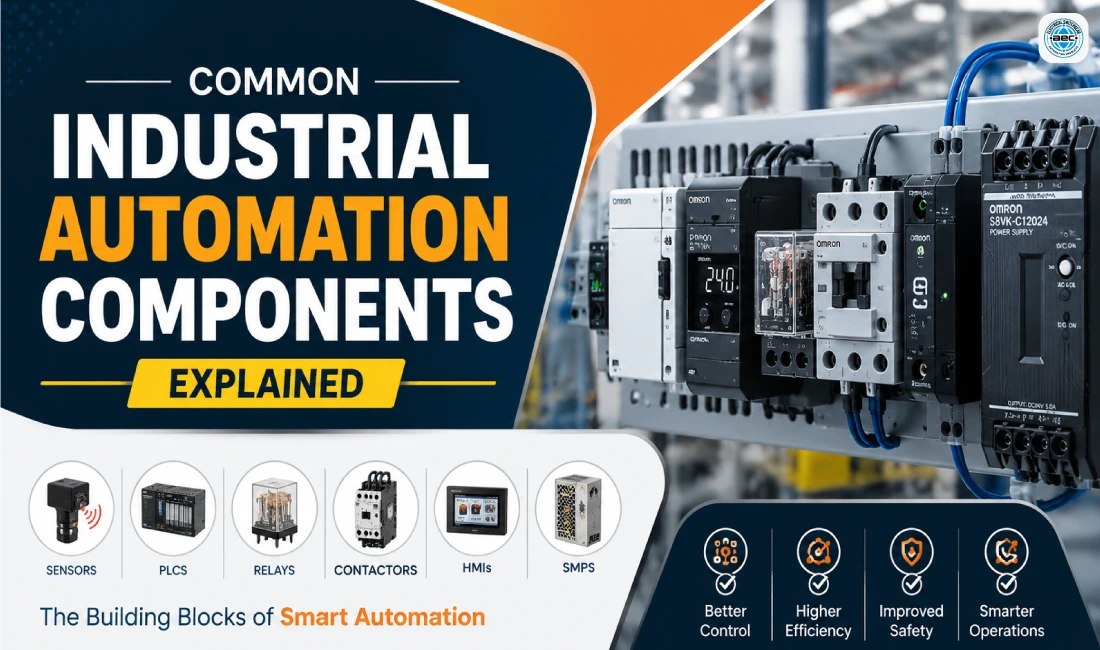
Industrial automation has become an important part of modern manufacturing, packaging, processing, material handling, and machine-building operations. Automated machines rely on several electrical and electronic devices to sense conditions, process information, control equipment, and perform physical operations with minimum manual intervention. Understanding these devices is useful for automation engineers, maintenance teams, machine manufacturers, electrical contractors, OEMs, and industrial buyers. In a typical automation system, different components perform different jobs but work together as one control system. Sensors collect information from the machine, PLCs process that information, relays and contactors control electrical circuits, actuators perform physical movement, and HMIs allow operators to monitor machine conditions. Supporting components such as SMPS units, switches, indicators, and communication equipment complete the control architecture. This guide to Automation Components Explained covers the most commonly used industrial automation components and explains their role in practical applications. It also highlights how selecting suitable industrial electrical products can improve the reliability and maintainability of automated equipment. For businesses looking for industrial electrical and automation products, Aarcee Electrical Controls offers a wide range of products for industrial applications. Its portfolio includes automation products, control gear, sensors, relays, SMPS, switches, LED indicators, push buttons, and other electrical components from established manufacturers.
What Are Industrial Automation Components?
Industrial automation components are the hardware devices used to monitor, control, switch, communicate, and operate machinery automatically. They form the basic building blocks of an industrial control system and allow machines to respond to changing conditions without requiring constant manual operation. Depending on the application, an automation system may contain sensors, PLCs, relays, contactors, power supplies, HMIs, motors, actuators, switches, and communication equipment. The basic automation process can be understood as detect, process, decide, control, act, and monitor. A sensor detects an object or condition and sends information to a PLC. The PLC processes that information according to its programmed logic and produces an output signal. That output can operate a relay, contactor, motor, solenoid valve, or another actuator. Different industries require different combinations of automation components. A conveyor system may need proximity sensors, PLCs, contactors, motors, and indicators, while a process plant may require temperature sensors, pressure devices, valves, PLCs, HMIs, and SCADA systems. The component selection should always match the machine’s electrical, mechanical, environmental, and operational requirements. Understanding Automation Components Explained is therefore not simply about knowing product names. It is about understanding how individual devices communicate and cooperate inside an automation system. Correct component selection can help reduce machine downtime, improve control accuracy, simplify maintenance, and support consistent production. Aarcee Electrical Controls provides industrial electrical and automation products for businesses that require reliable components for control panels, machinery, manufacturing systems, and industrial installations. Its product categories make it possible to source several related electrical and automation requirements through one supplier.
Sensors: The Eyes and Ears of Automation
Sensors are one of the most important parts of an automated machine because they provide information about the physical environment. They can detect objects, position, temperature, pressure, level, movement, distance, speed, and other conditions. The sensor converts the detected condition into a signal that can be processed by a PLC or another control device. Proximity sensors are commonly used for detecting objects without physical contact, particularly in machinery and production lines. Photoelectric sensors can detect objects using light, while temperature and pressure sensors provide information about process conditions. Limit switches and position sensors can also confirm whether a mechanical component has reached a particular position. For example, on an automated conveyor, a proximity sensor can detect when a metal component reaches a particular point. The sensor sends an input to the PLC, which evaluates the programmed conditions and then commands the next machine operation. This simple interaction demonstrates why sensors are fundamental to industrial automation components. Sensor selection should consider sensing distance, target material, operating voltage, output type, response time, mounting arrangement, temperature, dust, moisture, vibration, and other environmental factors. Selecting the wrong sensor can lead to false detection, missed products, machine stoppages, and unnecessary maintenance. Aarcee Electrical Controls offers automation products including Omron sensing solutions. Its website lists products such as the Omron E2B-M30LN20-WP-C1 2M proximity sensor for industrial detection applications. Customers can review product specifications before selecting a sensor for their particular machine or control application. As manufacturing becomes increasingly automated, accurate sensing becomes even more important. Reliable sensors provide the information required for machine sequencing, product detection, counting, positioning, monitoring, and process control.
PLCs: The Brain of an Automation System
A Programmable Logic Controller, or PLC, is the main control device used in many industrial automation systems. It receives information from sensors and other input devices, processes that information according to programmed logic, and controls output devices. PLCs are widely used in manufacturing machines, conveyors, packaging systems, assembly equipment, process plants, and material-handling applications. A PLC continuously reads its inputs, executes its program, and updates its outputs. Because this process occurs very quickly, the controller can manage repetitive machine operations with consistent timing. This reduces the need for manual decision-making and allows production equipment to follow programmed sequences automatically. Consider an automated filling machine. A sensor detects when a container reaches the filling position and sends an input to the PLC. The controller checks whether the machine is ready and whether the required conditions have been satisfied. If everything is correct, the PLC activates an output that operates the filling mechanism. One major advantage of PLC-based automation is flexibility. Machine logic can often be modified through programming when production requirements change. Additional sensors, outputs, timers, counters, interlocks, and communication functions can be incorporated depending on the PLC’s capabilities. When selecting a PLC, engineers should consider the number and type of inputs and outputs, processing requirements, communication ports, memory, expansion capability, programming environment, and future requirements. Choosing a controller should be based on the actual application rather than simply selecting the highest-rated model. Within Automation Components Explained, PLCs are the central connection between field information and machine action. Sensors provide information, the PLC makes decisions, and output devices perform the required operation.
Relays and Contactors for Industrial Control
Relays and contactors are important switching devices used to control electrical circuits in industrial automation systems. A relay allows a control signal to switch another circuit, while contactors are commonly used for switching larger electrical loads such as motors. Both components are widely found inside industrial control panels. A relay typically contains a coil and electrical contacts. When the coil receives the correct voltage, the contacts change state and allow another circuit to be controlled. Relays can be used for signal switching, electrical isolation, interlocking, and connecting PLC outputs to other control circuits. Contactors work on a similar principle but are designed for power switching applications. They are frequently used to control motors in conveyors, pumps, compressors, production machines, and material-handling systems. A PLC can initiate a control signal that ultimately energises a contactor and starts or stops a motor. Selection should consider coil voltage, contact configuration, current rating, switching frequency, load characteristics, electrical life, mechanical life, and environmental conditions. Motor-control circuits may also require suitable overload protection, short-circuit protection, isolation, and other protective equipment. Aarcee Electrical Controls provides industrial relay and control products, including products from Omron and other established manufacturers. Its product portfolio can help businesses source control components for automation panels and industrial electrical applications. Relays and contactors demonstrate an important principle of Automation Components Explained: automation requires both electronic decision-making and dependable electrical switching. The controller may decide what should happen, but switching equipment helps transfer that decision into the electrical system.
SMPS and Industrial Power Supplies
Industrial automation equipment requires a stable and suitable power source to operate correctly. Switched-mode power supplies, commonly called SMPS units, are widely used in control panels to provide regulated DC power to PLCs, sensors, relays, HMIs, communication equipment, and other electronic components. Many control systems use 24V DC equipment, although the required voltage depends on the individual application. Before selecting an SMPS, engineers should calculate the total connected load and consider operating conditions, startup requirements, future expansion, temperature, panel space, and required protection features. For example, a control cabinet may contain a PLC, several sensors, relays, indicator lights, and communication devices. All of these loads may depend on the control power supply. If the SMPS is incorrectly sized, the system may experience unstable operation or unexpected interruptions. Aarcee Electrical Controls offers Omron SMPS products, including models from the S8VK-C series. The website lists options such as S8VK-C06024, S8VK-C12024, S8VK-C24024, and S8VK-C48024 for different industrial power requirements. Power supply selection is sometimes overlooked when discussing Automation Components Explained, but it can directly influence system reliability. Even high-quality sensors and PLCs cannot operate properly if their power source is inadequate or unsuitable. For this reason, an industrial SMPS should be considered a core part of the control architecture rather than an optional accessory.
HMIs for Machine Monitoring and Operator Control
A Human-Machine Interface, or HMI, provides operators with a visual connection to an automated machine. Instead of relying only on physical switches and indicator lights, operators can use an HMI to view machine status, alarms, production information, process values, and operating conditions. An HMI generally communicates with a PLC or other controller and displays selected information in an easy-to-understand format. Depending on the machine design, authorised operators may also use it to change permitted settings, select operating modes, acknowledge alarms, or control specific functions. For example, a packaging machine can display production counts, machine speed, operating status, fault messages, and process information on its HMI. If the machine stops because a sensor fails, the HMI can display an alarm that helps the operator identify the problem more quickly. Good HMI design should focus on clarity rather than displaying excessive information. Important alarms, machine status, controls, and process values should be easy to locate and understand. HMIs can also support maintenance by providing information such as fault histories, counters, operating hours, or diagnostic messages, depending on the control system. This can help maintenance teams identify recurring issues. As factories move toward connected and data-driven production, HMIs are becoming increasingly important. They form a practical connection between people and machines and are therefore an important part of modern industrial automation components.
Actuators and Motors
Actuators convert control commands into physical movement, making them the part of the automation system that performs the actual mechanical action. They may operate valves, move components, drive conveyors, clamp workpieces, position products, or perform other machine operations. Electric motors are among the most common industrial actuators. They are used in conveyors, pumps, fans, compressors, mixers, machine tools, and production equipment. Depending on the application, motors may be controlled using contactors, starters, variable-frequency drives, servo systems, or other control equipment. Pneumatic actuators are also widely used when fast linear movement is required. A PLC can activate a solenoid valve, which controls compressed air supplied to a cylinder. The cylinder then extends or retracts according to the programmed machine sequence. Servo motors are suitable for applications requiring accurate positioning, speed control, acceleration, or coordinated movement. They are commonly found in packaging machinery, robotics, precision assembly systems, and advanced manufacturing equipment. Actuator selection should consider load, speed, positioning accuracy, duty cycle, available power, environmental conditions, and mechanical requirements. Selecting a device that is too small can result in poor performance, while unnecessary oversizing can increase costs. In Automation Components Explained, actuators represent the stage where an electrical or electronic decision becomes physical machine movement. They therefore need to be correctly matched with the controller and the mechanical system.
Push Buttons, Indicators and Industrial Switches
Even highly automated machines continue to use physical controls because operators and maintenance teams often need simple, immediate access to basic machine functions. Push buttons, selector switches, indicator lights, and industrial switches remain common components in control panels. Push buttons can be used for start, stop, reset, jog, or other machine functions, while selector switches may be used to choose operating modes. Indicator lights provide quick visual information about power, machine status, faults, or selected modes. Aarcee Electrical Controls offers LED and push-button products for industrial control applications. These products can be useful for control-panel builders and machine manufacturers that need clear visual indicators and physical operator controls. Industrial switches may also be used for switching, isolation, changeover, or other electrical control functions. Aarcee’s portfolio includes products from manufacturers such as Salzer, covering industrial switching requirements. When selecting these components, engineers should check electrical ratings, contact configuration, mounting requirements, environmental conditions, mechanical durability, and application requirements. Safety-critical functions should always use appropriately designed and rated safety equipment rather than ordinary control components. These devices may be simple, but they remain valuable parts of a practical industrial automation system because they provide direct interaction between people and equipment.
How Industrial Automation Components Work Together
The most important thing to understand about Automation Components Explained is that individual products work together as a complete system. A sensor detects a condition, the PLC processes the information, a relay or contactor transfers the control command, and an actuator performs the required physical operation. For example, a proximity sensor can detect a component on a conveyor and send a signal to the PLC. The PLC evaluates its programmed conditions and sends an output command. That command can operate a relay, contactor, valve, motor, or another actuator depending on the application. The actuator then performs the required machine action, while additional sensors can provide feedback to confirm that the operation has occurred. At the same time, an HMI can display the machine condition to the operator.
A simplified automation sequence can therefore be represented as:
Sensor → PLC/Controller → Relay/Contactor → Actuator → Machine Action → Feedback
Supporting components such as SMPS units, switches, indicators, protection devices, terminals, and communication equipment keep the overall system functional and manageable. This integrated approach is why industrial automation should always be designed as a complete system. Component compatibility, electrical ratings, environmental conditions, communication requirements, safety considerations, and future expansion all need to be considered before final selection.
Why Correct Automation Component Selection Matters
Selecting the right automation components can have a direct impact on machine reliability, production efficiency, maintenance requirements, and equipment life. A sensor with the wrong sensing range can cause detection problems, while an undersized power supply can create instability across the control system. Similarly, an incorrectly rated relay or contactor may not be suitable for the connected load. Engineers should evaluate voltage, current, switching capacity, sensing requirements, response time, environmental conditions, installation method, communication compatibility, and expected operating cycles. The component should also be compatible with the rest of the machine’s electrical and control architecture. For industrial buyers, product availability and technical support are also important considerations. Working with an established supplier can make it easier to source multiple components and obtain relevant product information. Aarcee Electrical Controls provides a broad range of industrial electrical and automation products for manufacturing companies, OEMs, machine builders, automation professionals, and other industrial customers. Its product categories include automation products, relays, SMPS, LED and push buttons, switches, and other industrial electrical equipment. By understanding the function of each component before purchasing it, businesses can make more informed decisions and build control systems that are better suited to their actual operating requirements.
Final Thoughts on Automation Components Explained
Industrial automation is built from many individual components, but each component has a specific role within the overall control system. Sensors provide information, PLCs process that information, relays and contactors control electrical circuits, SMPS units provide control power, HMIs allow operators to monitor equipment, and actuators convert commands into physical movement. The purpose of Automation Components Explained is therefore to make this system easier to understand for engineers, technicians, machine builders, industrial buyers, and businesses exploring automation. Once the relationship between inputs, controllers, outputs, and feedback becomes clear, selecting suitable components becomes much easier. Reliable automation depends on more than simply purchasing individual products. Components must be electrically compatible, correctly rated, suitable for the environment, and appropriate for the machine’s operating conditions. Proper installation, protection, programming, commissioning, and maintenance are equally important. For businesses searching for industrial automation components, control gear, sensors, relays, SMPS, switches, push buttons, and other industrial electrical products, Aarcee Electrical Controls provides a broad product range from established manufacturers. Explore the available products and technical information through Aarcee Electrical Controls to identify components suitable for your industrial automation and electrical control requirements.
FAQs
Have questions? We’ve answered some of the most common queries to help you understand the topic better.
Q1. What are the main components used in industrial automation?
The main components include sensors, PLCs, relays, contactors, SMPS units, HMIs, actuators, motors, switches, indicators, communication equipment, and suitable protection devices.
Q2. What is the most important role of a PLC in automation?
A PLC processes signals received from input devices such as sensors and executes programmed logic to control outputs and machine operations.
Q3. Why are sensors important in industrial automation?
Sensors provide real-time information about physical conditions such as object presence, position, temperature, pressure, level, and movement, allowing the control system to make appropriate decisions.
Q4. Where are industrial automation components used?
They are used in manufacturing plants, packaging machines, conveyors, process industries, automotive production, material handling, machine tools, assembly lines, and many other industrial applications.
Q5. Where can I buy industrial automation components?
Aarcee Electrical Controls offers industrial automation and electrical products, including sensors, relays, SMPS, switches, push buttons, control gear, and products from established industrial brands.