
Rotary Encoders: How They Work and Where They Are Used

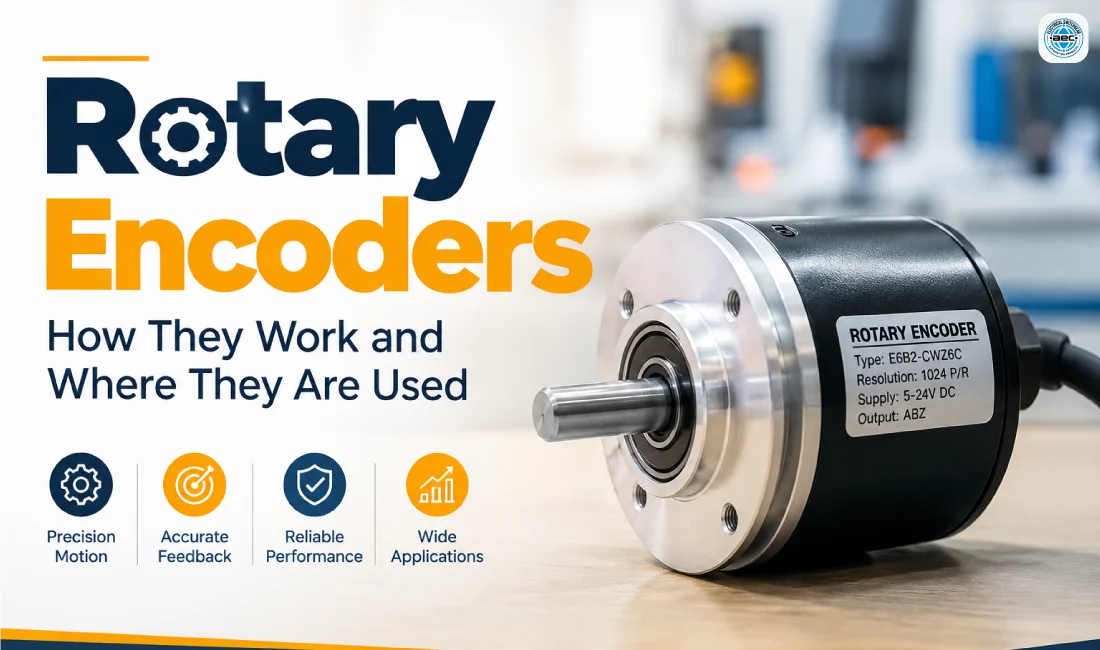
Machines used in modern manufacturing need accurate information about movement to operate reliably. A motor may rotate a shaft, conveyor, roller, or mechanical assembly, but the control system also needs to know how that movement is taking place. Rotary Encoders provide this essential feedback by converting shaft rotation into electrical signals that a PLC, controller, servo drive, or automation system can understand. These devices are widely used in industrial automation, CNC machines, robotics, packaging equipment, conveyor systems, servo motors, elevators, and other motion-control applications. Depending on the design, an encoder can provide information about rotational position, speed, direction, and movement. Understanding the working principle, types, sensing technologies, applications, and selection factors can help engineers and machine designers choose the right encoder for their equipment.
What Are Rotary Encoders?
A Rotary Encoder is an electromechanical sensing device that measures the rotation of a shaft and converts it into an electrical output. The output can then be processed by a control system to determine how far the shaft has moved, how quickly it is rotating, or which direction it is turning. This makes the encoder an important link between the mechanical and electronic parts of an automated machine. The basic operation involves a rotating element connected to the shaft and a sensing mechanism that detects its movement. Depending on the technology, this sensing can be performed using light, magnetic fields, inductive principles, or physical contacts. The resulting electrical signals are transferred to a controller for further processing. In industrial applications, encoder feedback allows equipment to perform controlled and repeatable movement. Instead of relying only on a motor command, the control system receives information about actual shaft movement.
How Do Rotary Encoders Work?
When the shaft connected to an encoder rotates, an internal sensing mechanism detects the change in its angular position. The encoder then generates an electrical signal corresponding to that movement. The signal is sent to a PLC, motor controller, servo drive, or another electronic device that interprets the information. Optical encoders typically use a rotating coded disc, light source, and receiver. As the disc rotates, its pattern changes the light reaching the sensing element, creating electrical transitions. Magnetic encoders use a rotating magnetic element and sensor to detect changes in the magnetic field. The output can contain pulses or coded position information depending on the encoder type. A controller can use these signals to calculate speed, direction, position, or the number of rotations. This feedback is particularly useful in closed-loop motion-control systems where precise movement is required.
What Are the Main Types of Rotary Encoders?
The two main categories are incremental encoders and absolute encoders. An incremental encoder produces pulses as the shaft rotates, allowing a controller to track relative movement from a known reference point. Many models use A and B channels in quadrature, allowing the system to determine both movement and direction. An absolute encoder provides a coded value representing the shaft’s actual angular position. This allows the controller to identify position directly rather than relying only on accumulated pulses. Absolute models can also be designed as single-turn or multi-turn encoders. The choice between these technologies depends on the machine’s requirements. Incremental devices are often suitable for speed and relative-position feedback, while absolute devices are useful where direct position information is important.
Where Are Rotary Encoders Used?
Rotary Encoders are used in many industries because accurate rotational feedback is required by a wide range of machines. In industrial automation, they can monitor conveyor motors, rollers, drives, and rotating mechanisms. In CNC equipment, encoder feedback supports controlled movement and positioning. Robotic systems can use encoders to monitor motor and joint movement, while packaging machines use them to synchronize feeding, cutting, filling, sealing, and labeling operations. Servo motors also commonly use encoder feedback for controlled speed and position. Other applications include elevators, printing machines, textile equipment, material-handling systems, inspection machinery, and automated production lines. Even simpler rotary controls found in electronic equipment can use rotary sensing technology to detect knob movement.
What Are Incremental Rotary Encoders?
Incremental Rotary Encoders generate electrical pulses as the shaft rotates. The control system counts these pulses to determine the amount of relative movement. Because the output changes continuously as the shaft moves, incremental encoders are useful for speed measurement, direction detection, and position tracking. Quadrature encoders commonly provide two signals, known as A and B. Their phase relationship allows the controller to identify the direction in which the shaft is turning. Some models also provide an index or Z signal that supplies a reference point once per revolution. A key characteristic is that an incremental encoder does not inherently provide absolute shaft position after power is removed. A machine may therefore need a reference or homing process when its exact starting position is important.
What Are Absolute Rotary Encoders?
Absolute Rotary Encoders provide a unique coded output associated with a shaft’s angular position. Instead of simply counting pulses from a reference point, the control system can obtain position information directly from the encoder output. Single-turn absolute encoders provide position information within one revolution, while multi-turn models can also track multiple shaft rotations. This makes absolute technology useful in applications where position needs to be known immediately. These encoders are commonly considered for precision machinery, robotics, servo systems, machine tools, and automated positioning equipment. When selecting an absolute model, engineers should check resolution, communication interface, speed, shaft configuration, environmental protection, and compatibility with the controller.
What Factors Should You Consider When Choosing an Encoder?
Selecting a suitable encoder starts with understanding the machine’s actual requirements. The first decision is generally whether the application needs incremental or absolute feedback. Resolution is another important factor because it determines how finely rotational movement can be detected. The encoder’s maximum operating speed should also match the machine. Shaft size, mounting arrangement, available space, and coupling requirements are important mechanical considerations. Electrical specifications such as supply voltage, output signal, communication interface, and controller compatibility must also be checked. Environmental conditions can significantly affect encoder selection. Temperature, dust, moisture, vibration, oil, chemicals, and mechanical shock may require a more suitably protected design. Reviewing all these factors helps ensure that the encoder performs reliably in its intended application.
Why Is Encoder Resolution Important?
Encoder resolution indicates how finely a device can detect or represent rotational movement. For an incremental encoder, resolution is commonly associated with the number of pulses produced during one revolution. A higher pulse count can provide more detailed movement information, provided that the controller can process the signal correctly. For absolute encoders, resolution relates to the number of distinct position values available within the measurement range. Higher resolution can be useful in precision positioning applications, but selecting the highest possible resolution is not always necessary. The correct resolution depends on the machine, required accuracy, operating speed, controller capability, mechanical transmission, and application. Resolution should therefore be considered as part of the complete motion-control system rather than as an isolated specification.
What Are the Benefits of Rotary Encoders?
The main advantage of Rotary Encoders is their ability to provide real-time feedback about mechanical rotation. This information allows a control system to monitor speed, position, direction, and movement instead of relying only on predefined motor commands. Encoder feedback can improve motion control, machine repeatability, synchronization, and positioning. In a conveyor system, for example, feedback can help determine how far a conveyor has travelled. In robotics, it can provide information about motor or joint position. They are available in different resolutions, sensing technologies, shaft configurations, output types, and protection levels. This flexibility allows manufacturers to select an encoder suited to a wide variety of machines and operating environments.
How Are Rotary Encoders Used With Servo Motors?
Servo systems require feedback to control motor movement accurately. A Rotary Encoder attached to the motor or associated mechanism can monitor shaft movement and send information back to the servo drive or controller. The control system can compare the required movement with actual feedback and make adjustments to motor operation. Depending on the system, encoder information can be used for position, speed, and direction control. This makes encoders particularly useful in robotics, CNC machines, automated assembly systems, packaging machinery, and other precision motion applications. The encoder must be compatible with the servo drive in terms of electrical output, communication method, resolution, and mechanical installation.
Conclusion
Rotary Encoders are important feedback devices used to measure and monitor rotational movement in automated machinery. By converting shaft rotation into electrical signals, they provide controllers with information about speed, direction, position, and movement. Incremental encoders are commonly used for pulse-based movement and speed feedback, while absolute encoders provide coded position information. Optical, magnetic, and other sensing technologies provide different options for various operating environments and performance requirements. From industrial automation and CNC machines to robotics, conveyors, packaging equipment, and servo motors, encoder feedback supports controlled and repeatable machine operation. Choosing the correct product requires consideration of resolution, speed, output, mounting, environmental conditions, and controller compatibility. If you are looking for encoder solutions for industrial or automation applications, explore the Aarcee Electrical Rotary Encoders to review available products and specifications.
FAQs
Have questions? We’ve answered some of the most common queries to help you understand the topic better.
Q1. What is a Rotary Encoder?
A Rotary Encoder is a sensor that converts shaft rotation into electrical signals used to measure movement, speed, direction, or position.
Q2. What is an incremental encoder?
An incremental encoder generates pulses as a shaft rotates. These pulses can be counted to determine relative movement and speed.
Q3. What is an absolute encoder?
An absolute encoder provides coded position information corresponding to the shaft’s angular position.
Q4. Where are Rotary Encoders used?
They are commonly used in CNC machines, robotics, conveyors, packaging equipment, servo motors, elevators, and industrial automation.
Q5. How do I choose the right Rotary Encoder?
Consider encoder type, resolution, speed, output, shaft configuration, mounting requirements, environmental conditions, and controller compatibility.
