Types of Automatic Transfer Switch (ATS)

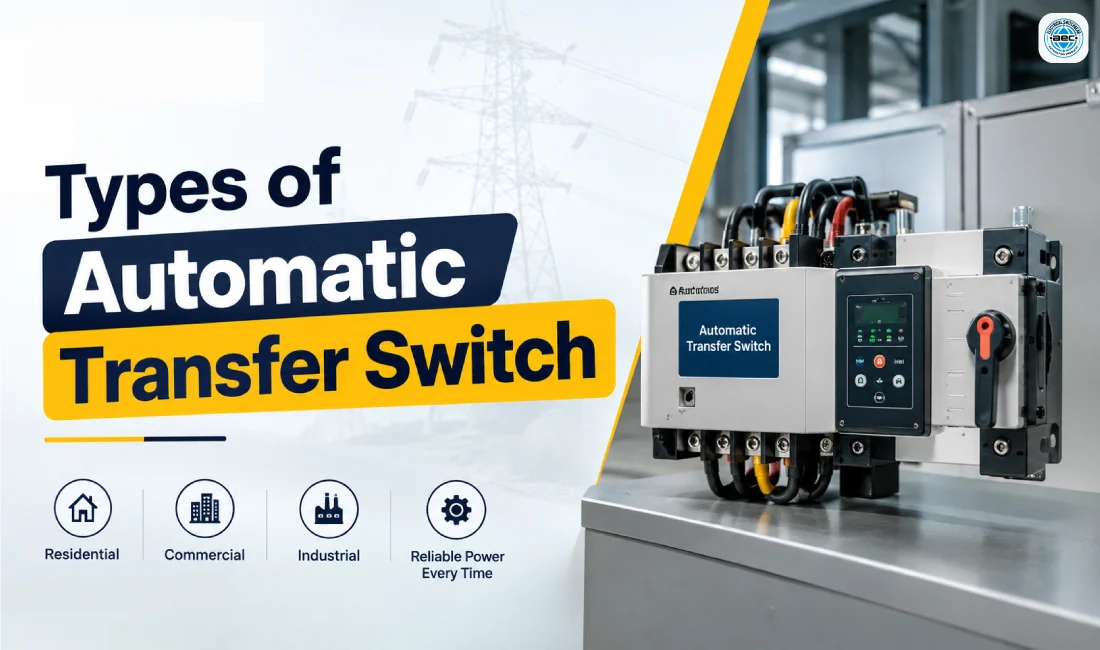
An Automatic Transfer Switch (ATS) is an important electrical switching device used to transfer a connected load from a primary power source to a backup source when the main supply fails or becomes unsuitable. It is commonly used with generators, inverters, secondary utility supplies, and other standby power systems. Unlike a manual changeover switch, an Automatic Transfer Switch can monitor the available power sources and complete the transfer automatically according to programmed operating conditions. ATS systems are widely used in homes, commercial buildings, hospitals, data centres, industries, offices, and other locations where an unexpected power interruption can affect safety, productivity, equipment, or business operations. The switch continuously monitors factors such as voltage and, depending on the model, frequency and phase conditions. When the normal supply becomes unavailable, the ATS can initiate the backup source and transfer the load once the alternate supply becomes stable. There are different types of Automatic Transfer Switches, and the right option depends on the application, electrical load, backup source, required transfer time, and type of equipment being powered. The most common transition arrangements include open transition, closed transition, delayed transition, and open in-phase transition. Understanding these options makes it easier to select an ATS that matches the requirements of a particular electrical system.
What Is an Automatic Transfer Switch and How Does It Work?
An Automatic Transfer Switch connects an electrical load to a preferred power source under normal operating conditions and automatically transfers that load to an alternate source when the primary supply fails. In a typical generator backup system, the utility supply is the normal source and the generator acts as the emergency source. The ATS remains connected to the normal supply while continuously checking whether the incoming power is within the programmed operating limits. If the utility voltage disappears or becomes unacceptable, the controller detects the condition and sends a start signal to the standby generator. Once the generator reaches the required voltage and frequency, the ATS transfers the selected load from the utility source to the generator. The exact transfer sequence depends on the type of ATS and its programmed settings. When utility power returns, the ATS does not necessarily switch back immediately. It normally waits for the normal source to remain stable for a predetermined period before reconnecting the load. The generator may then continue running for a cooldown period before shutting down.
The basic ATS operating sequence can therefore be understood in four steps:
- Monitoring: The ATS continuously checks the condition of the normal power source.
- Detection: It identifies a power failure, voltage problem, frequency issue, or other programmed abnormal condition.
- Transfer: It starts or communicates with the standby source and transfers the load when the alternate source is ready.
- Restoration: After the normal supply becomes stable again, it transfers the load back and allows the standby source to shut down.
This automatic process is one of the main reasons ATS equipment is used in backup power installations. It reduces dependence on manual operation and helps ensure that important electrical loads can receive power from an alternative source when the main supply is interrupted.
What Are the Main Types of Automatic Transfer Switch?
The main types of Automatic Transfer Switch are generally classified by the way they transfer the electrical load between two power sources. The three commonly discussed options are open transition, closed transition, and delayed transition. Some advanced ATS systems also provide open in-phase transition, which can be useful for specific motor and inductive-load applications. Open Transition ATS operates using a break-before-make method. The normal source is disconnected before the alternate source is connected, which creates a brief interruption in power. This is one of the most common ATS arrangements because it provides a relatively simple and dependable transfer method for applications where a short interruption is acceptable. It can be suitable for homes, offices, commercial buildings, general equipment, and many standby generator systems. The actual interruption period depends on the system, controller settings, generator response, and switching equipment, so it should not be assumed that every open transition ATS has exactly the same transfer time. Closed Transition ATS uses a make-before-break method. In this arrangement, the alternate source is connected before the normal source is disconnected, allowing the load to remain powered during the transfer. However, both sources must be properly synchronised before they can be temporarily connected together. Voltage, frequency, and phase relationships must meet the required conditions. Because of these additional requirements, closed transition ATS systems are more sophisticated and require careful system design. They are commonly considered for critical applications such as hospitals, data centres, industrial processes, and facilities where even a short interruption during a planned transfer is undesirable. Delayed Transition ATS introduces a controlled delay between disconnecting one source and connecting the other. This can be useful for electrical systems containing large motors, transformers, pumps, compressors, and other inductive loads. These types of equipment can retain residual voltage after the original source has been disconnected. A controlled delay gives the residual voltage time to decrease before the alternate source is connected. This can help reduce unwanted electrical effects during the transfer. The delay should always be selected according to the actual equipment and electrical system rather than using one standard value for every installation. Open In-Phase Transition is another specialised transfer method. It remains an open transition because the two sources are not intentionally connected together, but the controller attempts to perform the transfer when the sources reach a suitable phase relationship. This can be useful for certain motor loads where a conventional open transfer could produce undesirable electrical effects. Depending on the equipment, the controller may use another transfer strategy if the required in-phase condition cannot be achieved within the programmed time. The best Automatic Transfer Switch is therefore not simply the one with the highest rating or most features. The transition method should match the type of load, backup source, required continuity, and electrical design of the installation.
How to Choose the Right Automatic Transfer Switch?
Selecting the correct Automatic Transfer Switch requires more than checking the ampere rating. The first consideration should be the electrical load that the ATS needs to handle. The switch should have an appropriate current rating for the connected load, while the system designer should also consider starting currents from motors, pumps, compressors, and other equipment. Choosing an ATS that is too small can create reliability and safety problems, while unnecessarily selecting a much larger unit can increase the project cost. The voltage and phase configuration are also important. You need to determine whether the installation uses single-phase or three-phase power and confirm the required operating voltage and frequency. The number of poles and neutral arrangement should also match the electrical system. These details become particularly important when selecting an ATS for generators, commercial buildings, industrial machinery, or larger distribution systems. The backup source should be considered before selecting the equipment. An ATS may be used with a standby generator, inverter, secondary utility supply, or another approved power source. Generator-based systems often require communication between the ATS and generator controller so that the generator can automatically start when the normal supply fails. The ATS must then recognise when the generator has reached suitable operating conditions before transferring the load. The type of load is another major factor. A basic residential installation may only require an open transition ATS, while a facility with large motors may benefit from delayed or in-phase transfer. Critical environments may require closed transition or more advanced ATS configurations to reduce interruptions. The operating environment should also be considered, including indoor or outdoor installation, enclosure requirements, temperature, moisture, dust, and available installation space. It is also useful to consider controller features and maintenance requirements. Depending on the application, features such as adjustable time delays, source monitoring, alarms, manual operation, event indication, communication functions, bypass arrangements, and remote monitoring may be valuable. Always check the manufacturer’s specifications and have the complete installation reviewed by a qualified electrical professional. For buyers comparing products, the Automatic Transfer Switch price can vary significantly according to current rating, voltage, number of poles, transition type, controller features, enclosure, brand, and application. A compact residential ATS will generally have different pricing from a high-current industrial transfer switch. Therefore, comparing products only on price can lead to an unsuitable selection. The better approach is to compare the specifications against the actual requirements of the electrical system.
Where Are Automatic Transfer Switches Used?
Automatic Transfer Switch systems are used wherever an alternative power supply is required and automatic source transfer can improve reliability. Residential applications may use ATS equipment to transfer essential household circuits between utility power and a generator or inverter. This can be useful for lighting, refrigerators, security systems, communication equipment, and other selected loads during a power failure. Commercial buildings often use ATS systems for emergency lighting, HVAC equipment, pumps, security systems, communication equipment, servers, and other important electrical loads. In these environments, a power interruption can affect employees, customers, building operations, or sensitive equipment, making reliable backup power management important. Industrial facilities may have more demanding ATS requirements because their electrical systems can include motors, production machinery, pumps, compressors, control systems, and other high-current equipment. The transfer method must be selected carefully because starting currents and residual voltages can affect how the system behaves during a source change. Critical facilities such as hospitals, data centres, emergency services, and important infrastructure may require advanced ATS arrangements because power continuity can be extremely important. Depending on the system design, these facilities may use closed transition, delayed transition, bypass-isolation, redundant sources, or other specialised power-transfer arrangements. Regardless of the application, the ATS should be considered as part of the complete power system rather than as an isolated switching product. Generator capacity, protection devices, cable sizing, earthing, neutral configuration, load characteristics, and source compatibility all need to work together for dependable operation.
Benefits of Using an Automatic Transfer Switch
The primary benefit of an Automatic Transfer Switch is that it can transfer electrical loads between power sources without requiring someone to manually operate the switch during every outage. This can be especially useful when the building is unattended or when a rapid response to power failure is important. An ATS can also work together with standby generators by sending an automatic start command when the normal supply fails. Once the generator becomes ready, the ATS can transfer the selected load. When utility power returns and remains stable, the ATS can automatically transfer the load back and allow the generator to complete its cooldown cycle. Another advantage is controlled switching. Depending on the selected ATS type, the system can be configured to suit general loads, inductive equipment, or applications where continuity during transfer is particularly important. Modern ATS controllers can also provide source-status information and other operational indications that make monitoring and maintenance easier. For businesses and industries, automatic source transfer can reduce downtime and help protect important operations. For residential users, it provides convenience because there is no need to manually change the power source during an outage. The overall benefit, however, depends on selecting, installing, and maintaining the correct ATS for the electrical system.
Conclusion
Choosing the right Automatic Transfer Switch is essential for creating a dependable backup power system. Open transition ATS is a practical option for many general applications, while closed transition is suited to systems where maintaining power during an approved transfer is especially important. Delayed transition can be useful for motor and inductive loads, while open in-phase transition provides a specialised option for controlled switching. The correct ATS should always be selected according to the electrical load, voltage, current rating, phase configuration, backup source, transition requirements, and installation conditions. A properly selected and installed ATS can make generator and backup-power systems more convenient, reliable, and responsive during power interruptions. For suitable ATS products and electrical switching solutions, you can explore the Automatic Transfer Switch product category at Aarcee Electrical. For technical information about ATS operation and transition methods, manufacturers such as Eaton and Schneider Electric also provide useful reference material for electrical professionals.
FAQs
Have questions? We’ve answered some of the most common queries to help you understand the topic better.
Q1. What is an Automatic Transfer Switch?
An Automatic Transfer Switch automatically transfers an electrical load between a primary power source and a backup source when the normal supply fails or becomes unsuitable.
Q2. What are the main types of ATS?
The main types include open transition, closed transition, delayed transition, and open in-phase transition ATS systems.
Q3. Can an ATS be used with a generator?
Yes. Many ATS systems are specifically designed to work with standby generators and can automatically initiate the generator-start and load-transfer sequence.
Q4. Which ATS is best for motors?
Delayed transition or open in-phase transition may be suitable for certain motor-heavy systems, depending on the equipment and electrical design.
Q5. How do I choose an ATS?
Check the load current, voltage, phase, backup source, transition requirement, number of poles, load characteristics, installation environment, and required control features before selecting an ATS.