Types of Power Supplies in Electronics: A Complete Guide


Power is one of the most important requirements of every electronic and industrial electrical system. From small electronic circuits and sensors to PLC panels, automation machines and industrial control systems, every device needs a suitable and stable source of electrical energy. This is why understanding the Types of Power Supplies is important for electrical engineers, electricians, technicians, panel builders, automation professionals and industrial buyers. A power supply does not simply deliver electricity; it converts electrical energy into the voltage, current and form required by connected equipment. Different applications may require AC power, regulated DC power, isolated output or a specific current capacity, making power supply selection an important part of system design. In industrial environments, the right power supply also works together with wiring, cable management, terminal connections and control components to create a safe and reliable installation. Aarcee Electrical Controls provides industrial electrical, control and automation products, including SMPS and related electrical components for different industrial applications.
What Is a Power Supply and Why Is It Important?
A power supply is an electrical device that converts and controls electrical energy so that another electrical or electronic device can operate within its required voltage and current range. The electricity available from the main source is not always suitable for electronic components, so a power supply may need to convert AC to DC, change one DC voltage into another or regulate an unstable input. For example, many industrial control circuits use 24V DC even though the primary electrical supply available to the installation is AC. The power supply converts the available input into a suitable and controlled DC output for sensors, controllers, relays and other equipment. A properly selected power supply can also provide important protection functions such as overload protection, short-circuit protection, overvoltage protection and thermal protection. This becomes particularly important in industrial automation because a failure in the control power supply can affect an entire machine or production process. Power supplies are also important because different electrical components have different power requirements. A PLC may require a particular DC voltage, while sensors, relays, timers and communication devices may have their own current requirements. Selecting a power supply therefore involves more than checking whether the output voltage matches the equipment. Engineers and technicians must also consider the total current consumption, power rating, efficiency, environmental conditions and available installation space. In a control panel, the power supply should work reliably alongside other components and should have suitable protection against expected electrical conditions. The installation also needs properly selected conductors and connection accessories. Products such as Flexible Wire Single Core, PVC Duct, Junction Box, Terminal Box and TM Box can support organized wiring and electrical connections around industrial power and control systems. A complete installation should therefore be planned as a system rather than treating the power supply as an isolated component.
What Are the Main Types of Power Supplies?
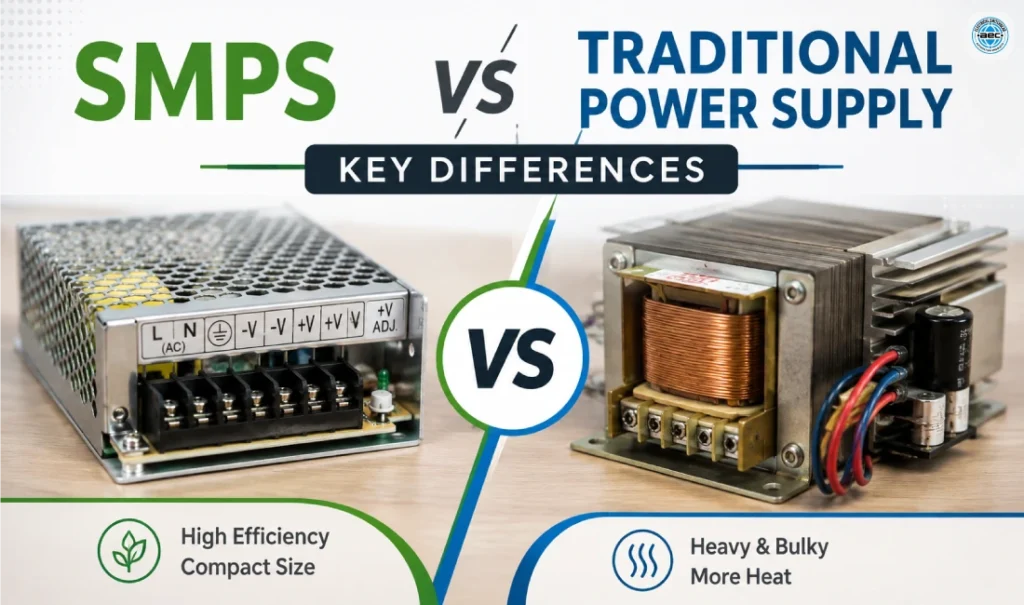
There are several Types of Power Supplies used in electronics and industrial applications, with each type designed for particular electrical requirements. The most common categories include linear power supplies, switched-mode power supplies, AC-to-DC power supplies, DC-to-DC converters, regulated power supplies and unregulated power supplies. A linear power supply uses a conventional voltage reduction and regulation method and is known for its simple design and relatively low electrical noise. A switched-mode power supply, commonly called an SMPS, uses high-frequency switching technology to achieve efficient voltage conversion in a compact design. AC-to-DC power supplies convert alternating current into direct current, while DC-to-DC converters change one DC voltage level into another. Regulated supplies are designed to maintain a stable output despite normal variations in input voltage or load, whereas unregulated supplies allow their output voltage to vary more significantly according to operating conditions. Among these different options, SMPS technology is particularly common in modern industrial automation because of its efficiency, compact construction and ability to provide regulated DC output. Linear power supplies may still be appropriate where low electrical noise is a major requirement, while DC-to-DC converters are useful where an existing DC source needs to be converted to another voltage. The correct choice depends on the application, equipment specifications and operating environment. Industrial users should always check the manufacturer’s technical specifications before selecting a power supply. Input voltage, output voltage, output current, power rating, efficiency, protection features, mounting method and temperature range can all affect the suitability of a particular model. Aarcee Electrical Controls offers industrial electrical and automation products, including SMPS solutions for control and automation applications. Its product range includes Omron SMPS families such as S8FS-C, S8VK-C, S8VK-G, S8VK-S and S8VK-T, giving industrial users different options depending on their application and required specifications. The S8VK-C series, for example, includes different output ratings designed for industrial control applications. When choosing an SMPS, users should compare the exact input and output specifications of the required model rather than selecting a product based only on its series name.
Why Is SMPS Widely Used in Industrial Applications?
A Switched-Mode Power Supply is designed to convert electrical energy using high-frequency switching technology. In a typical AC-input SMPS, the incoming AC supply is first processed through an input and rectification stage. The resulting electrical energy is then switched at a high frequency using electronic switching components. Depending on the design, a high-frequency transformer or conversion stage provides the required voltage transformation and isolation. The output is subsequently rectified and filtered to provide the required DC voltage. A feedback circuit monitors the output and adjusts the switching operation when the load or input conditions change. This process allows the SMPS to maintain a controlled output while achieving better efficiency and a smaller physical size than many traditional power supply designs. The efficiency and compact construction of SMPS units make them useful for industrial control panels where space and heat management are important. Control panels may contain PLCs, sensors, relays, controllers, timers and communication equipment, all of which can require dependable DC power. A compact DIN-rail-mounted power supply can be integrated into the panel without taking excessive space. Higher efficiency can also reduce unnecessary heat generation, which is useful in equipment that operates for long periods. However, an SMPS must still be selected according to the actual electrical load and environmental conditions. An undersized supply may experience overload conditions, while an unsuitable input range or insufficient protection can create reliability problems. Aarcee Electrical Controls is relevant for industrial customers looking for these types of products because its range includes industrial electrical, control gear and automation components. In addition to SMPS, businesses can source associated electrical products that help complete control-panel installations. Flexible Wire Single Core can be used for suitable internal electrical wiring applications, while PVC Duct helps organize cables inside control panels. Junction Box, Terminal Box and TM Box products can provide structured solutions for electrical connections and terminations depending on the application. Using suitable supporting components is important because the reliability of a power system depends not only on the power supply itself but also on the quality and organization of the complete electrical installation.
How to Choose the Right Power Supply?
Choosing the right power supply begins with understanding the electrical requirements of the equipment that needs to be powered. The first consideration is the input voltage. A power supply must be compatible with the AC or DC source available at the installation. The next consideration is the required output voltage, which must match the operating requirements of the connected equipment. Current capacity is equally important because the power supply must be able to provide enough current for the complete connected load. If several sensors, relays, controllers or other devices are connected to the same supply, their combined requirements should be considered before selecting the unit.Power rating and efficiency should also be evaluated. A supply that is continuously operated close to or beyond its recommended capacity may not provide the desired reliability. It is often useful to consider additional capacity where future expansion is expected. Efficiency becomes especially important in industrial installations that operate continuously because energy lost during conversion can become heat. Protection features are another important consideration. Depending on the application, users may need protection against overload, short circuit, overvoltage and excessive temperature. These features can help protect both the power supply and connected equipment from certain electrical fault conditions. The physical design of the power supply should also match the installation. DIN-rail mounting can be useful in industrial control panels, while other applications may require panel-mounted or enclosed solutions. Available space, ventilation, ambient temperature and wiring access should be considered before installation. The surrounding wiring should also be properly organized. PVC Duct can help route cables neatly, while Flexible Wire Single Core can support suitable internal wiring where the cable specifications match the application. Terminal and connection products such as Terminal Box, Junction Box and TM Box can help create structured connection points. This combination of suitable power supply, wiring and connection accessories can make the electrical system easier to inspect, maintain and troubleshoot.
Applications of Power Supplies in Electronics and Automation
The different Types of Power Supplies are used in almost every area where electrical or electronic equipment requires controlled power. Industrial automation is one of the most common applications, with power supplies used for sensors, PLC systems, control relays, controllers, timers and other low-voltage equipment. Manufacturing machinery can use power supplies within control panels to operate electronic control circuits while motors and other high-power equipment are supplied through their respective electrical circuits. Instrumentation systems can also require regulated power because measurement devices may be sensitive to voltage fluctuations. Power supplies are also used in communication systems, monitoring equipment, building automation, security systems, testing equipment and electronic instruments. The exact type depends on the application’s voltage, current, efficiency, isolation and protection requirements. For example, an industrial control panel may require a regulated 24V DC supply, while another electronic application may need a DC-to-DC converter to obtain a different voltage from an existing DC source. This is why there is no single power supply suitable for every application. In industrial environments, the surrounding installation is equally important. Proper wiring, cable management and electrical termination can improve the organization and serviceability of a control system. Components such as Flexible Wire Single Core, PVC Duct, Junction Box, Terminal Box and TM Box can form part of the supporting electrical infrastructure depending on the design. Aarcee Electrical Controls provides a broad selection of industrial electrical and automation products, making it possible for industrial users, panel builders, OEMs and automation professionals to source multiple components required for electrical and control applications.
Why Choose Aarcee Electrical Controls for Power Supply and Electrical Products?
Selecting a dependable supplier is important when purchasing industrial electrical products because the quality, specifications and compatibility of components can directly affect the performance of an electrical system. Aarcee Electrical Controls has been serving industrial electrical and automation requirements since 2006 and provides products for manufacturers, OEMs, panel builders, automation integrators, contractors and other industrial customers. Its product range includes industrial electrical products, control gear, automation components, SMPS and associated electrical accessories. For customers planning a control panel or industrial electrical installation, sourcing related products from an experienced supplier can simplify procurement and product selection. Along with power supplies, users may need wiring products, cable management solutions, terminal and connection boxes, relays, sensors, controllers and other automation components. Aarcee Electrical Controls offers products covering many of these requirements, including Flexible Wire Single Core, PVC Duct, Junction Box, Terminal Box and TM Box. Customers can review the available product categories and technical information on the Aarcee Electrical Controls website before selecting products for their application. The most suitable power supply should always be selected according to the manufacturer’s specifications and the actual requirements of the electrical system. Users should verify input voltage, output voltage, current rating, power capacity, protection functions, mounting arrangement and environmental conditions before purchasing. With the right power supply and properly selected supporting components, industrial control systems can be designed in a more organized and reliable manner. For businesses looking for industrial SMPS and electrical automation products, Aarcee Electrical Controls can be considered as a source for a range of electrical and control requirements.
Final Thoughts
Understanding the Types of Power Supplies helps electrical and automation professionals make better decisions when designing electronic circuits, control panels and industrial systems. Linear power supplies, SMPS units, AC-to-DC supplies, DC-to-DC converters, regulated supplies and unregulated supplies all serve different purposes. SMPS technology has become particularly popular in industrial applications because it can provide efficient and regulated power in a compact format. However, voltage and current requirements, power rating, efficiency, protection, mounting and environmental conditions should always be considered before selecting a product. A reliable power installation also requires suitable supporting components. Flexible Wire Single Core can support appropriate wiring applications, PVC Duct can help organize panel wiring, while Junction Box, Terminal Box and TM Box can provide useful solutions for electrical connections and terminations. These products, combined with a correctly selected power supply, can contribute to a well-organized industrial electrical system. For industrial businesses, OEMs, panel builders and automation professionals looking for SMPS and related electrical products, Aarcee Electrical Controls offers a broad industrial product range. Exploring the available products and checking their technical specifications before purchase can help ensure that the selected power supply and associated components are suitable for the intended application.
FAQs
Have questions? We’ve answered some of the most common queries to help you understand the topic better.
Q1. What are the main Types of Power Supplies?
The main types include linear, SMPS, AC-to-DC, DC-to-DC, regulated and unregulated power supplies.
Q2. What is an SMPS?
SMPS is a switched-mode power supply that uses high-frequency switching to provide efficient and regulated electrical output.
Q3. Why is 24V DC used in automation?
24V DC is commonly used for industrial control circuits, sensors, relays and other automation components.
Q4. How do I select a power supply?
Check input voltage, output voltage, current, power rating, protection, efficiency, mounting and operating conditions.
Q5. Where can I buy industrial SMPS products?
Aarcee Electrical Controls supplies SMPS and a wide range of industrial electrical and automation products.