Essential Electrical Protection Devices for Industrial Systems


Industrial electrical systems are the backbone of modern manufacturing plants, warehouses, processing units, automation facilities, commercial buildings, and infrastructure projects. These systems operate with high electrical loads, motors, control panels, automation equipment, sensors, drives, and distribution networks that must remain reliable throughout demanding operating conditions. A sudden overload, short circuit, voltage fluctuation, phase failure, earth leakage, or electrical surge can damage expensive equipment and interrupt production. This is why selecting suitable Electrical Protection Devices is one of the most important parts of industrial electrical system design. From MCBs and MCCBs to overload relays, motor protection devices, current transformers, voltage monitoring relays, and surge protection equipment, every component has a specific role in maintaining electrical safety and system reliability. For industries looking for dependable industrial electrical products in India, Aarcee Electrical Controls provides a wide range of power distribution, control gear, automation, relay, protection, and electrical measurement products for industrial applications. Aarcee Electrical Controls has been serving manufacturers, OEMs, panel builders, contractors, automation integrators, and industrial businesses since 2006.
Why Electrical Protection Devices Are Essential for Industrial Systems
Industrial electrical installations require much more than simply supplying power to machines because every circuit must also be protected against abnormal operating conditions. Electrical Protection Devices help detect dangerous electrical conditions and either disconnect the affected circuit or initiate an appropriate control response before the problem develops into equipment failure or a major safety incident. Overloads can gradually increase motor temperature, while short circuits can produce extremely high fault currents within a very short period. Voltage abnormalities and phase problems can affect motors, automation equipment, measurement instruments, and sensitive electronic components connected to the same electrical network. Proper protection also helps isolate faults closer to the affected circuit, reducing unnecessary shutdowns across an entire production facility. For industrial plants in India, protection selection should consider load characteristics, supply voltage, fault levels, equipment ratings, operating environment, and applicable electrical standards. A well-designed protection system therefore combines different protective components rather than relying on one device to handle every possible electrical fault. Aarcee Electrical Controls offers power distribution and protection-related products including MCBs, current transformers, motor starters, industrial relays, control relays, under-voltage and over-voltage relays, and other industrial electrical components.
Molded Case Circuit Breakers for Industrial Power Distribution
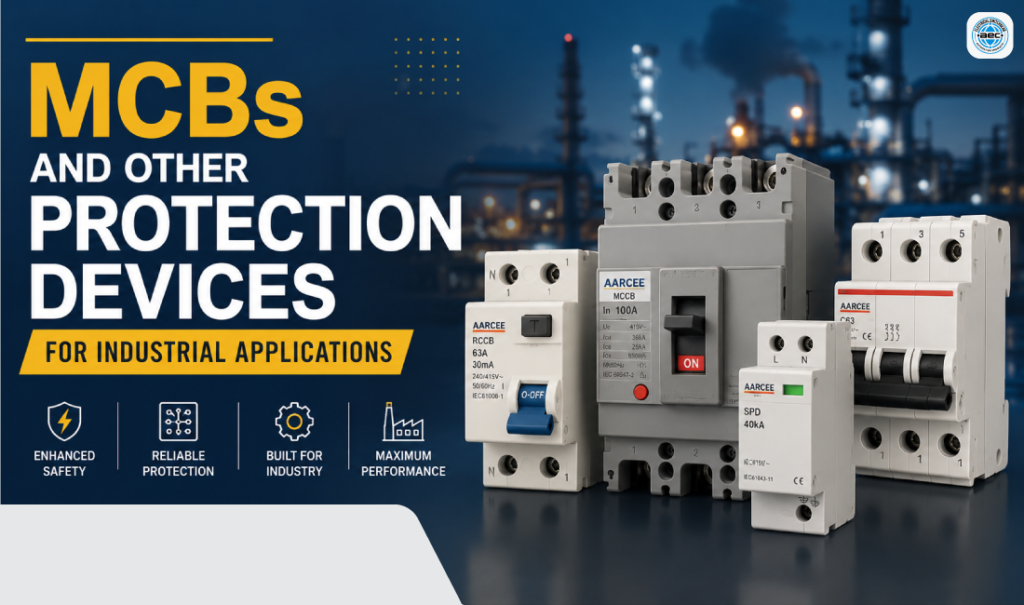
Molded Case Circuit Breakers, commonly called MCCBs, are important Electrical Protection Devices used for higher-current industrial circuits, feeders, distribution systems, and heavy electrical loads. An MCCB can provide protection against overloads and short circuits while also allowing the circuit to be manually switched or isolated when required. Compared with smaller circuit breakers, MCCBs are designed for applications where higher current capacity and greater fault interruption capability may be required. They are commonly considered for main incomers, outgoing feeders, motors, generators, capacitor banks, industrial machinery, and distribution panels. The correct MCCB selection should consider rated current, voltage, breaking capacity, number of poles, trip characteristics, ambient conditions, and coordination with upstream and downstream protective equipment. Adjustable protection settings available on many MCCB designs can be useful when engineers need to coordinate protection with different load conditions and distribution levels. For industrial buyers, selecting the correct MCCB from a reliable electrical supplier is important because an incorrectly selected breaker can lead to nuisance tripping or inadequate fault protection. Aarcee Electrical Controls supplies industrial electrical and control gear products and works with established brands including BCH Electric, KEI Industries, Omron Automation, Rishabh Instruments, Salzer Electronics, and Socomec.
Miniature Circuit Breakers for Local Circuit Protection
Miniature Circuit Breakers, or MCBs, are widely used to protect smaller industrial circuits, control circuits, auxiliary loads, lighting circuits, and individual electrical sub-circuits from overcurrent conditions. An MCB automatically interrupts the circuit when the current exceeds the safe operating limit according to its protection characteristics. This makes MCBs valuable in industrial control panels where several smaller circuits may need independent protection and isolation. Using separate MCB protection for individual circuits can also make fault finding easier because a problem in one circuit does not necessarily require the shutdown of every connected circuit. The selection of an MCB should consider rated current, voltage, number of poles, tripping characteristics, breaking capacity, and the nature of the connected load. Industrial MCBs are available in different configurations and ratings, so the correct model should always be matched with the actual electrical design rather than selected only by physical size or price. Aarcee Electrical Controls currently lists MCBs within its Power Distribution category, with multiple MCB products available through its online product range.
Industrial Fuses for Fast Short-Circuit Protection
Industrial fuses continue to be useful Electrical Protection Devices because of their simple construction, rapid fault interruption, and ability to limit severe short-circuit currents in suitable applications. A fuse contains an element designed to melt when excessive current flows through it, disconnecting the circuit and preventing continued fault current from reaching downstream equipment. Fuses can be used in industrial control panels, motor circuits, power supplies, transformer circuits, semiconductor applications, and other systems where specific fuse characteristics are required. Unlike an MCB or MCCB, a conventional fuse must normally be replaced after it operates, which means maintenance teams need suitable replacement fuses available for critical equipment. Fuse selection involves considering voltage rating, current rating, breaking capacity, fuse class, time-current characteristics, and the characteristics of the connected equipment. In motor applications, fuse selection also needs to account for starting current so that normal motor starting does not cause unwanted operation. When coordinated correctly with other protective devices, industrial fuses can provide effective and fast protection against severe electrical faults. The best protection arrangement depends on the electrical system design, available fault current, equipment requirements, and the recommendations of the equipment manufacturer.
Thermal Overload Relays for Motor Protection
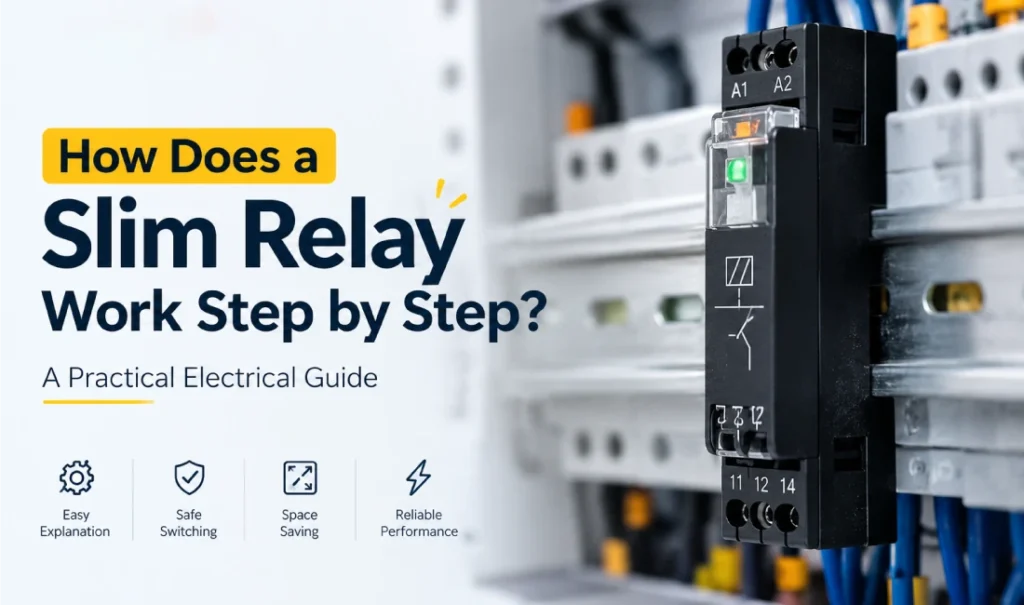
Electric motors are among the most important electrical loads in industrial facilities, powering pumps, compressors, conveyors, fans, machine tools, production equipment, and automated machinery. A motor that continuously operates above its intended current can generate excessive heat, which may damage winding insulation and shorten the useful life of the motor. Thermal overload relays are designed to monitor motor current and respond when a prolonged overload condition occurs. These devices are normally used with motor contactors and control circuits, allowing the motor supply or control circuit to be interrupted when an overload is detected. It is important to understand that an overload relay and a short-circuit protective device perform different functions and should not automatically be treated as interchangeable components. Proper motor protection may therefore involve a combination of a circuit breaker or fuse, contactor, overload relay, and additional phase or voltage monitoring depending on the application. For industrial automation and motor control systems, selecting protection according to the motor’s rated current, starting characteristics, duty cycle, and operating environment is essential. Aarcee Electrical Controls also provides industrial automation and relay products that can complement broader motor control and electrical protection requirements.
Motor Protection Circuit Breakers for Industrial Motors
Motor Protection Circuit Breakers, often referred to as MPCBs, are specifically designed for protecting electric motor circuits and can combine multiple protective functions depending on the selected model. Motor circuits experience characteristics that are different from ordinary resistive loads because motors can draw significantly higher current during starting and may experience overloads during mechanical or process-related problems. A suitable motor protection circuit breaker can help protect against overload and short-circuit conditions while also providing a convenient means of switching or isolating the motor circuit. Some motor protection arrangements also incorporate phase-failure or phase-imbalance protection, which is particularly valuable for three-phase industrial motors. Correct adjustment is important because a setting that is too low may cause nuisance tripping during normal operation, while an unnecessarily high setting can reduce the effectiveness of motor protection. The motor’s full-load current, starting method, duty cycle, supply voltage, ambient temperature, and manufacturer recommendations should all be considered when choosing protection. Motor protection is especially important in manufacturing environments because unexpected motor failure can stop conveyors, pumps, compressors, production machinery, or automated processes. Aarcee Electrical Controls’ Power Distribution and Industrial Automation categories include motor-related and protection-oriented products that can support industrial control system requirements.
Residual Current Devices for Earth Leakage Protection
Residual Current Devices, including RCDs and RCCBs, are designed to respond to differences between current flowing through the intended conductors, helping identify leakage current that may be travelling through an unintended path to earth. This type of protection is particularly important where electrical equipment, conductive enclosures, or exposed parts could present a shock hazard if an insulation fault occurs. RCD and RCCB protection performs a different function from conventional overcurrent protection, so it should not simply be considered a replacement for an MCB or MCCB. The correct device depends on the electrical system, leakage characteristics of connected equipment, required sensitivity, system configuration, and installation requirements. Industrial facilities with electronic equipment may have naturally occurring leakage currents, making appropriate device selection and coordination especially important. Incorrect selection can result in nuisance operation, while inadequate protection may fail to provide the intended level of safety. Electrical protection should therefore be designed as an integrated system where leakage protection, short-circuit protection, overload protection, earthing, and isolation work together. For complex installations, qualified electrical professionals should determine the appropriate protection architecture and settings.
Phase Monitoring Relays for Three-Phase Equipment
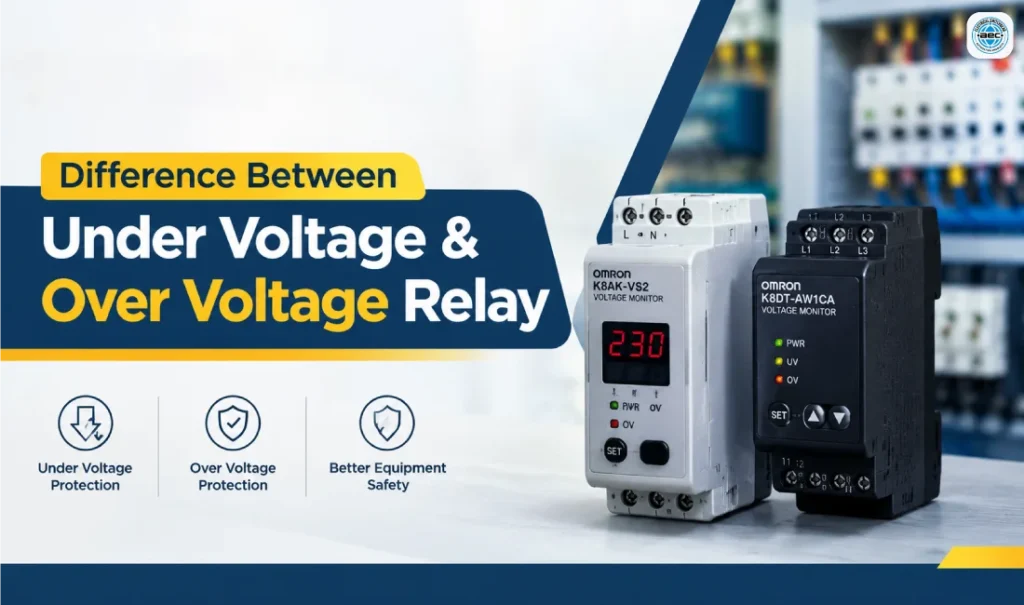
Three-phase industrial machinery can be seriously affected by phase loss, incorrect phase sequence, voltage imbalance, and other supply abnormalities that may not be detected by ordinary overcurrent protection alone. Phase monitoring relays are designed to monitor electrical supply conditions and provide a control response when selected abnormal conditions are detected. This can help protect motors, pumps, compressors, HVAC equipment, machine tools, and other three-phase equipment from operating under unsuitable supply conditions. Phase loss can cause a motor to operate abnormally and may result in increased current and excessive heating in the remaining phases. Incorrect phase sequence can cause a motor to rotate in the wrong direction, which can create operational or mechanical problems in certain machines. Voltage monitoring can also help identify under-voltage and over-voltage conditions that could affect connected electrical equipment. Aarcee Electrical Controls lists Under Voltage & Over Voltage Relays within its Relays & Protection category, alongside industrial relays, control relays, safety relays, terminal relays, solid-state relays, and contactors.
Surge Protective Devices for Industrial Equipment
Surge Protective Devices, commonly known as SPDs, help protect electrical and electronic equipment against transient overvoltages that can result from events such as lightning activity, switching operations, and disturbances within an electrical network. Modern industrial facilities contain increasingly sensitive electronics, including PLCs, HMIs, sensors, communication equipment, power supplies, measurement systems, and automation controllers. These components can be vulnerable to transient voltage events even when the normal supply voltage appears stable. An SPD works by limiting the transient overvoltage and diverting surge energy through an appropriate protective path according to its design and installation arrangement. Effective surge protection depends not only on selecting an SPD but also on correct installation, conductor routing, earthing, coordination, and placement within the electrical distribution system. Industrial facilities may require a layered approach to surge protection depending on the building, incoming supply, equipment sensitivity, and exposure to external surge events. The selected SPD should therefore match the system voltage, earthing arrangement, expected surge environment, and equipment requirements. For industrial automation systems where electronic control equipment is critical to production, surge protection should be considered as part of the overall electrical reliability strategy.
Current Transformers and Electrical Monitoring
Current Transformers, or CTs, are important components in industrial electrical measurement and protection systems because they allow electrical current to be measured by compatible meters, monitoring equipment, and protection systems. Rather than connecting a measurement instrument directly to a high-current conductor, a CT provides a scaled current signal that can be used by suitable equipment for monitoring and measurement. CTs are commonly found in industrial distribution panels, energy monitoring systems, metering arrangements, control panels, and electrical protection applications. Accurate current measurement can help maintenance teams understand load behaviour, identify abnormal current conditions, and monitor the performance of electrical equipment. CT selection should consider primary current, secondary current, accuracy class, burden, frequency, installation arrangement, and the requirements of the connected measurement or protection device. Aarcee Electrical Controls currently lists Current Transformers within its Power Distribution category, including products such as the TE05-315081B. This makes current measurement another important part of the broader electrical control and protection ecosystem available through Aarcee Electrical Controls.
How to Select the Right Electrical Protection Devices
Selecting the correct Electrical Protection Devices requires a complete understanding of the electrical installation rather than choosing components based only on the normal operating current. Engineers and panel builders should first identify the type of load, supply voltage, phase arrangement, expected operating current, starting current, and prospective fault level. The protective device must have an appropriate rating and interrupting capability for the electrical system in which it will be installed. Environmental conditions such as ambient temperature, humidity, dust, vibration, chemicals, and enclosure type can also affect component selection and performance. Protection coordination should be considered so that the protective device closest to a fault can operate without unnecessarily disconnecting healthy sections of the installation. Motor circuits may require a different combination of protection compared with lighting, control, automation, heating, or electronic circuits. Selecting genuine products from recognised manufacturers and sourcing them through an experienced industrial electrical supplier can also simplify product identification, technical documentation, replacement, and after-sales support. Aarcee Electrical Controls maintains a broad industrial product portfolio and works with manufacturers and brands including BCH Electric, KEI Industries, Omron Automation, Rishabh Instruments, Salzer Electronics, and Socomec.
Common Industrial Applications of Electrical Protection Devices
The need for Electrical Protection Devices extends across almost every industry where electrical power and automation equipment are used to operate machinery. Manufacturing plants use MCBs, MCCBs, motor protection, overload relays, monitoring relays, and other protection components across production lines and distribution panels. Water treatment facilities depend on reliable motor protection for pumps and process equipment, while warehouses and logistics facilities may require protection for conveyors, automation systems, charging infrastructure, and distribution circuits. Food processing, packaging, pharmaceutical, textile, automotive, chemical, steel, and engineering industries all have different load characteristics but share the requirement for dependable electrical safety. OEM machine builders and panel manufacturers also need compact and reliable protection components that can be integrated into control cabinets without compromising system performance. Automation integrators may combine circuit protection with sensors, timers, counters, relays, SMPS units, contactors, and monitoring equipment to create complete machine control systems. Aarcee Electrical Controls serves manufacturers, OEMs, panel builders, automation integrators, contractors, and industrial businesses across India, making its product range relevant to a wide variety of industrial applications.
Why Choose Aarcee Electrical Controls for Industrial Electrical Products
A reliable electrical protection system starts with the right products, but it also depends on having access to an experienced supplier that understands industrial applications and product requirements. Aarcee Electrical Controls was established in 2006 and is based in Kundli, Haryana, serving industrial customers across India with electrical, control gear, and automation products. The company works with manufacturers, OEMs, panel builders, automation integrators, contractors, and industrial businesses that require dependable electrical and automation components. Its online product range includes MCBs, current transformers, motor starters, digital meters, industrial relays, control relays, terminal relays, safety relays, solid-state relays, voltage monitoring relays, contactors, sensors, timers, counters, EOCR products, SMPS systems, panel accessories, and other industrial components. Aarcee Electrical Controls also lists recognised brands including BCH Electric, KEI Industries, Omron Automation, Rishabh Instruments, Salzer Electronics, Socomec, Lauritz Knudsen Electrical & Automation, Kaycee Industries, and other industrial manufacturers. With stocked products, order processing, delivery support, datasheets, and technical product information available through its website, Aarcee Electrical Controls can be a practical sourcing partner for businesses looking for industrial electrical and automation products.
Build a Safer and More Reliable Industrial Electrical System
A dependable industrial electrical system requires a coordinated combination of protection, control, monitoring, and distribution equipment rather than relying on one protective component. MCCBs can provide protection for higher-current feeders and distribution circuits, while MCBs can protect smaller circuits and auxiliary loads throughout an industrial installation. Fuses can provide fast fault interruption in suitable applications, while overload relays and motor protection circuit breakers help safeguard motors against conditions that could otherwise result in overheating or equipment damage. RCDs and RCCBs address residual current protection, while phase and voltage monitoring relays can help protect three-phase equipment from abnormal supply conditions. SPDs add another layer of protection for sensitive electrical and automation equipment exposed to transient overvoltages, while current transformers and measurement devices help monitor electrical performance. By combining the right Electrical Protection Devices with appropriate installation, coordination, maintenance, and professional engineering, industrial businesses can improve electrical safety, equipment reliability, and operational continuity. If you are looking for MCBs, industrial relays, current transformers, voltage monitoring relays, motor starters, control gear, automation components, or other industrial electrical products, Aarcee Electrical Controls can help you find suitable products for your application. Visit the official Aarcee Electrical Controls website to explore its industrial electrical product range, brands, datasheets, and product categories. Explore Aarcee Electrical Controls
Conclusion
Choosing suitable Electrical Protection Devices is essential for protecting industrial machinery, electrical panels, motors, automation systems, control circuits, and personnel from a wide range of electrical risks. The right combination of MCCBs, MCBs, fuses, overload relays, MPCBs, residual current protection, phase monitoring relays, SPDs, and measurement components can create a more dependable and coordinated industrial electrical system. Protection should always be selected according to the actual application, load characteristics, fault level, system voltage, installation environment, and manufacturer’s specifications. For manufacturers, OEMs, panel builders, automation integrators, contractors, and industrial businesses in India, Aarcee Electrical Controls offers a broad range of electrical and automation products from recognised industrial brands. With its established presence since 2006 and product categories covering Power Distribution, Industrial Automation, Relays & Protection, Power Supplies & Wiring, and Control Devices & Accessories, Aarcee Electrical Controls is well positioned to support industrial electrical sourcing requirements.
FAQs
Have questions? We’ve answered some of the most common queries to help you understand the topic better.
Q1. What are Electrical Protection Devices?
Electrical Protection Devices protect industrial equipment and electrical circuits from overloads, short circuits, voltage faults, leakage, and surges.
Q2. Which protection device is used for motors?
MPCBs, overload relays, MCCBs, and phase monitoring relays are commonly used for industrial motor protection.
Q3. What is the difference between MCB and MCCB?
MCBs are generally used for smaller circuits, while MCCBs are designed for higher-current industrial applications.
Q4. Why are phase monitoring relays important?
They help protect three-phase equipment from phase loss, phase reversal, and voltage imbalance.
Q5. Where can I buy industrial Electrical Protection Devices?
Aarcee Electrical Controls supplies MCBs, relays, current transformers, motor starters, and other industrial electrical products.