MCBs and Other Protection Devices for Industrial Applications

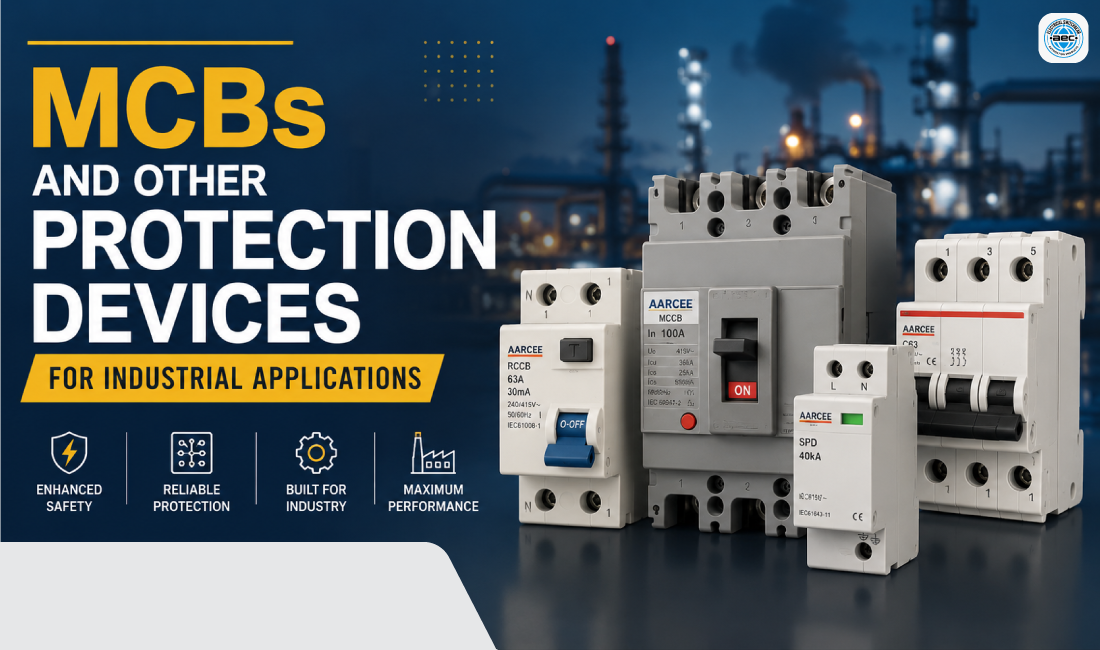
Industrial electrical systems power everything from motors and pumps to manufacturing machinery, control panels, automation systems, and production equipment. Because these systems often operate with high electrical loads, even a small fault can cause equipment damage, production downtime, or serious safety risks. This makes reliable electrical protection an essential part of industrial power distribution and machine safety. Protection Devices for Industrial Applications are designed to detect abnormal electrical conditions and disconnect or control affected circuits before the fault causes major damage. MCBs, MCCBs, RCCBs, RCBOs, surge protection devices, overload relays, and protection relays all perform different protection functions. Selecting the correct combination depends on the electrical load, fault level, cable capacity, equipment characteristics, and installation environment.For industrial electrical products and protection solutions, Aarcee Electricals offers products suitable for a range of electrical distribution and industrial requirements.
What Are Protection Devices for Industrial Applications?
Protection Devices for Industrial Applications are electrical components used to protect circuits, cables, machinery, panels, and people from abnormal electrical conditions.These devices can respond to overloads, short circuits, earth leakage, residual current, transient voltage surges, and other potentially dangerous conditions.When an electrical fault occurs, the appropriate protection device can disconnect the affected circuit and help limit the resulting damage.Industrial installations require carefully selected protection because they commonly contain motors, transformers, generators, automation systems, and high-current distribution equipment.A protective device that works well for a small lighting circuit may not be suitable for a large motor or industrial feeder.The correct solution therefore depends on factors such as current rating, voltage, breaking capacity, fault current, and equipment characteristics.Aarcee Electricals can help industries source electrical products suited to their specific protection and distribution requirements.
Miniature Circuit Breakers (MCBs)
Miniature Circuit Breakers, or MCBs, are commonly used to protect electrical circuits from overload and short-circuit conditions.An MCB automatically interrupts the circuit when the current exceeds its specified operating characteristics, helping prevent excessive heating and electrical damage.Unlike traditional fuses, MCBs can generally be reset after the fault has been identified and corrected, making them convenient for industrial applications.They are commonly used in control panels, distribution boards, lighting circuits, auxiliary circuits, small machinery, and other low-current applications. MCBs are available with different current ratings, pole configurations, breaking capacities, and tripping characteristics. Choosing the correct device requires consideration of both the normal operating current and the prospective short-circuit current at the installation point. For industrial applications, the MCB should also be selected according to the connected equipment and manufacturer’s technical specifications.
MCB Types and Tripping Characteristics
Different MCB tripping curves are designed for different types of electrical loads and starting-current conditions. Type B MCBs generally have a lower instantaneous tripping range and are commonly used where high inrush current is not expected. Type C MCBs are widely used for circuits with moderate inrush currents and may be suitable for certain motors, transformers, and industrial equipment. Type D MCBs have a higher instantaneous operating range and can be considered for applications involving high starting currents, such as certain heavy-duty motors and transformers. Some manufacturers also offer Type K characteristics for specific motor and inductive-load applications. The correct curve should be selected according to the actual load rather than simply choosing the most heavy-duty option available. Proper selection helps prevent nuisance tripping while maintaining effective short-circuit protection.
MCCBs for Industrial Power Distribution
Molded Case Circuit Breakers, or MCCBs, are commonly used when industrial electrical systems require higher current ratings and greater protection flexibility. They can be installed in main distribution panels, industrial feeders, generator circuits, transformer feeders, and circuits supplying large machinery. Depending on the model, MCCBs can offer adjustable protection settings and higher breaking capacities than typical MCBs. This makes them suitable for many high-current industrial distribution applications where fault levels and load currents are higher. MCCBs can also be incorporated into coordinated protection systems so that faults are isolated as close as possible to the affected circuit. Selection should consider rated current, breaking capacity, voltage, trip characteristics, number of poles, and the requirements of the connected load. Aarcee Electricals can provide industrial electrical product options for businesses requiring dependable circuit protection and power distribution equipment.
RCCB for Earth-Leakage Protection
Residual Current Circuit Breakers, commonly known as RCCBs, are designed to detect residual or leakage current and provide additional protection against electrical hazards. An RCCB monitors the current relationship between conductors and operates when an imbalance indicates that current may be flowing through an unintended path. This can help reduce risks associated with insulation faults, leakage currents, and certain electric-shock hazards. RCCBs perform a different function from MCBs and MCCBs because they are primarily designed for residual-current protection rather than conventional overload protection. For this reason, an RCCB is normally used as part of a wider protection system that includes appropriate overcurrent protection. Different RCCB ratings and sensitivities are available for different applications, so selection should follow the requirements of the electrical installation. In industrial facilities, RCCBs can provide an important additional layer of electrical safety when correctly specified and installed.
RCBO for Combined Protection
An RCBO combines residual-current protection with overload and short-circuit protection in a single device. This makes RCBOs useful for circuits where both overcurrent and earth-leakage protection are required at the individual circuit level. An RCBO can disconnect a circuit when excessive current occurs while also responding to specified residual-current conditions. Using individual RCBOs can help improve circuit separation because a fault on one protected circuit may not require the shutdown of unrelated circuits. RCBOs are available in different current ratings, residual-current sensitivities, pole configurations, and tripping characteristics. The selected device should match the electrical system, load, fault level, and manufacturer’s specifications. For compact industrial control and distribution arrangements, RCBOs can be a practical component of a broader protection strategy.
Surge Protection Devices for Industrial Equipment
Industrial facilities increasingly depend on sensitive electronics such as PLCs, variable-frequency drives, sensors, automation controllers, HMIs, and communication equipment.
These devices can be affected by transient overvoltages caused by lightning-related events, switching operations, and electrical network disturbances. Surge Protection Devices, or SPDs, are designed to limit or divert transient surge energy according to their design and installation arrangement. Proper surge protection can reduce the risk of damage to sensitive electronic equipment and improve the resilience of industrial control systems. The correct SPD depends on the electrical system configuration, installation location, expected surge environment, and coordination with other protective devices. For plants using extensive automation and electronic control equipment, surge protection should be considered as part of the overall electrical protection design. Combining SPDs with circuit breakers and other protection devices provides a more comprehensive approach to industrial electrical safety.
Motor Protection and Overload Relays
Electric motors are essential to industrial operations, powering pumps, compressors, conveyors, fans, mixers, machine tools, and production equipment. Motor protection must consider normal running current as well as starting current and possible overload conditions. Overload relays are commonly used with contactors and motor starters to protect motors against sustained overload conditions. Depending on the installation, additional protection may be required for short circuits, phase failure, phase sequence, under-voltage, over-voltage, or earth faults. The protection system should allow the motor to start normally without unnecessary tripping while still responding to abnormal operating conditions. Incorrect motor protection can result in frequent shutdowns or inadequate protection, both of which can affect productivity and equipment life. Properly selected motor protection devices therefore form an important part of reliable industrial electrical systems.
How to Select Protection Devices for Industrial Applications
Selecting Protection Devices for Industrial Applications requires consideration of the complete electrical system rather than only the equipment’s current rating. Start by determining the load current, supply voltage, phase configuration, cable capacity, and expected operating conditions. For motors and transformers, starting or inrush current should be considered when selecting MCB characteristics and other protection settings. The prospective short-circuit current should also be assessed so that the selected breaker has sufficient breaking capacity. Environmental factors such as temperature, dust, moisture, chemicals, vibration, and enclosure requirements can influence equipment selection. Protection devices should also be coordinated so that the device closest to a fault operates without unnecessarily disconnecting larger sections of the installation. For complex industrial systems, protection selection should be verified by qualified electrical professionals using applicable standards and manufacturer data.
Importance of Protection Coordination
Protection coordination helps ensure that different protective devices operate together in a predictable and selective manner. In a manufacturing facility, the electrical system may include a main incomer, distribution panels, feeders, motor circuits, and numerous machine connections.
If a fault occurs on one machine feeder, the preferred result is normally for the protection closest to that fault to operate while healthy circuits remain energized where safe. If an upstream main breaker trips instead, a relatively small fault could interrupt power to a much larger section of the plant. Engineers therefore consider breaker settings, time-current characteristics, fault levels, cable ratings, and motor starting conditions when designing protection systems. Good coordination can improve electrical reliability, simplify troubleshooting, and reduce unnecessary production downtime. It is therefore an important consideration when designing Protection Devices for Industrial Applications.
Industrial Electrical Products From Aarcee Electricals
Reliable electrical protection begins with selecting products that match the requirements of the installation and the equipment being protected. Aarcee Electricals provides industrial electrical products and solutions for businesses requiring equipment for electrical distribution, protection, control, and industrial applications. Its product range can support different industrial requirements, helping customers source electrical components according to their project specifications. Before selecting a product, customers should consider details such as voltage, current, motor rating, fault level, number of poles, installation environment, and application type. Providing accurate technical information helps ensure that the selected equipment is suitable for the intended electrical system. Businesses looking for industrial electrical products can explore the available solutions through the Aarcee Electricals website. Visit https://aarceeelectrical.com/ for product information and industrial electrical requirements.
Common Mistakes When Choosing Industrial Protection Devices
One common mistake is selecting a circuit breaker only according to the normal load current without checking breaking capacity or the actual fault level. Another problem is choosing an unsuitable MCB tripping characteristic for motors and transformers, which can cause nuisance tripping during startup. Using an RCCB as a complete replacement for overcurrent protection is also incorrect because residual-current and overcurrent protection perform different functions.
Poor coordination between upstream and downstream breakers can cause unnecessary shutdowns and increase production downtime. Ignoring environmental conditions can also affect the long-term performance of electrical protection equipment in harsh industrial locations. Regular inspection, testing, and maintenance should be included in the facility’s electrical maintenance program where applicable. Careful product selection and professional installation can significantly improve the safety and reliability of an industrial electrical system.
Conclusion
Industrial electrical systems require more than a single circuit breaker to achieve effective protection. MCBs, MCCBs, RCCBs, RCBOs, SPDs, overload relays, and protection relays each address different electrical risks and can work together as part of a coordinated protection system. MCBs are widely used for smaller circuits, while MCCBs are suitable for many higher-current industrial feeders and distribution applications.RCCBs and RCBOs provide residual-current protection, while SPDs help protect sensitive equipment from transient overvoltages. Motor protection and overload devices add another important layer of protection for machinery used in manufacturing and industrial processes. The correct Protection Devices for Industrial Applications should always be selected according to load characteristics, fault levels, breaking capacity, cable ratings, environmental conditions, and coordination requirements. For industrial electrical products and protection solutions, businesses can explore Aarcee Electricals and its product offerings at https://aarceeelectrical.com/.
FAQs
Have questions? We’ve answered some of the most common queries to help you understand the topic better.
Q1. What are Protection Devices for Industrial Applications?
They are electrical devices designed to protect industrial circuits, machinery, cables, panels, and people against conditions such as overloads, short circuits, earth leakage, and voltage surges.
Q2. What is the difference between an MCB and an MCCB?
MCBs are generally used for lower-current circuits, while MCCBs are designed for higher-current applications and may provide adjustable protection settings and higher breaking capacities.
Q3. Can an RCCB replace an MCB?
No. An RCCB primarily provides residual-current protection, while an MCB provides overload and short-circuit protection. Both may be required in an industrial protection system.
Q4. Which MCB type is suitable for industrial motors?
Type C is commonly used for moderate inrush applications, while Type D may be suitable for circuits with substantially higher starting currents. The correct choice depends on the motor and circuit characteristics.
Q5. How do I choose industrial protection equipment?
Consider load current, voltage, cable capacity, short-circuit level, breaking capacity, starting current, environmental conditions, and coordination requirements before selecting the appropriate device.