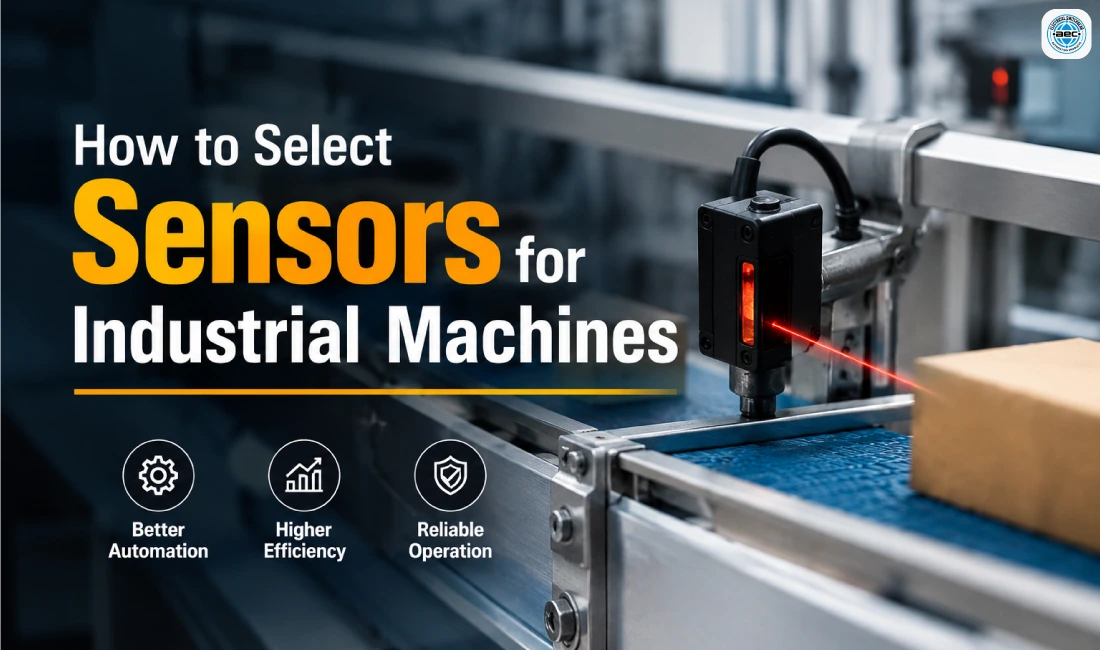
How to Select Sensors for Industrial Machines

Industrial automation depends heavily on accurate and reliable sensing. Whether a machine is counting products on a conveyor, checking the position of a component, monitoring temperature, detecting metal parts, or controlling an automated process, sensors provide the information that allows the control system to respond correctly. Choosing the right industrial sensor is therefore an important decision for manufacturers, OEMs, automation integrators, and maintenance teams. A suitable sensor can improve machine reliability, reduce unnecessary downtime, support consistent production, and make automated processes more dependable. However, selecting a sensor only by price or brand is not enough. Factors such as sensing technology, target material, sensing distance, output type, operating voltage, response time, mounting arrangement, and environmental conditions all need to be considered. In this guide, we explain how to select sensors for industrial machines, compare common sensor technologies, identify important specifications, discuss practical industrial applications, and explain what businesses should consider before purchasing automation components. We also cover how sensors and controls can influence LED Lighting Upgrade Cost when industrial facilities combine automated lighting with electrical and control systems.
What Is an Industrial Sensor?
An industrial sensor is an electronic or electromechanical device designed to detect a physical condition and convert that information into an electrical signal that a machine or control system can understand. Sensors essentially act as the information-gathering layer of an automated machine, allowing controllers to understand what is happening within a production process. Depending on the application, a sensor may detect an object, measure temperature, monitor pressure, identify movement, determine position, measure distance, or detect changes in another physical condition. The signal can then be processed by a PLC, controller, relay, counter, display, or other automation equipment. This makes sensors one of the most important building blocks of modern industrial automation.
Common industrial sensor applications include:
- Object detection
- Position detection
- Machine counting
- Temperature monitoring
- Pressure measurement
- Level detection
- Motion detection
- Speed monitoring
- Distance measurement
- Automated inspection
- Conveyor control
- Machine safety and interlocking applications
A simple example is a conveyor system where a sensor detects a product approaching a particular station. The sensor sends a signal to the control system, which may then stop the conveyor, activate an actuator, start another process, or count the product. A reliable sensor therefore does much more than simply detect an object; it becomes part of the machine’s decision-making process.
Why Is Sensor Selection Important for Industrial Machines?
Selecting the correct sensor is important because the performance of the entire automation sequence can depend on a small sensing device working accurately at the right moment. A sensor that is unsuitable for the target material, sensing distance, electrical circuit, or industrial environment may produce inconsistent signals or fail prematurely. In a high-speed production environment, even a small sensing error can result in incorrect counting, product rejection, machine stoppage, or production delays. The right sensor should therefore be selected according to the actual operating conditions rather than simply based on its purchase price. Proper sensor selection can also simplify maintenance because technicians can identify and replace components more easily when the specifications are correctly matched. For businesses investing in automation, reliable sensing is an important part of building a stable and efficient machine.
Correct sensor selection can contribute to:
- Better machine reliability
- More consistent production
- Faster automated processes
- Reduced manual intervention
- Improved product counting
- Better machine monitoring
- Reduced unnecessary downtime
- Easier maintenance
- Improved process control
- More dependable automation
For industrial buyers, it is also useful to consider product availability, technical documentation, manufacturer support, replacement availability, and compatibility with existing equipment.
What Are the Main Types of Industrial Sensors?
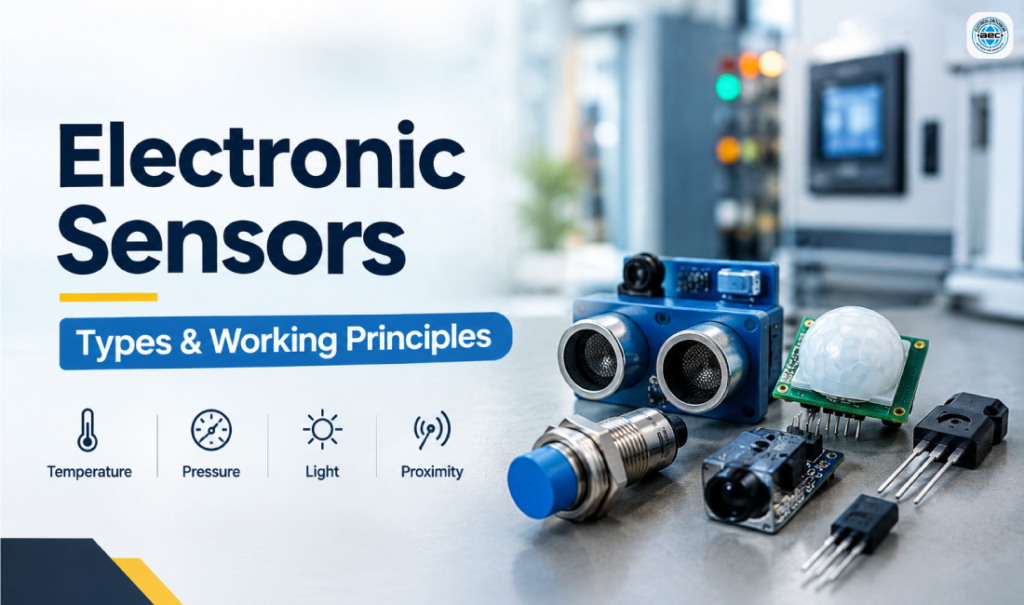
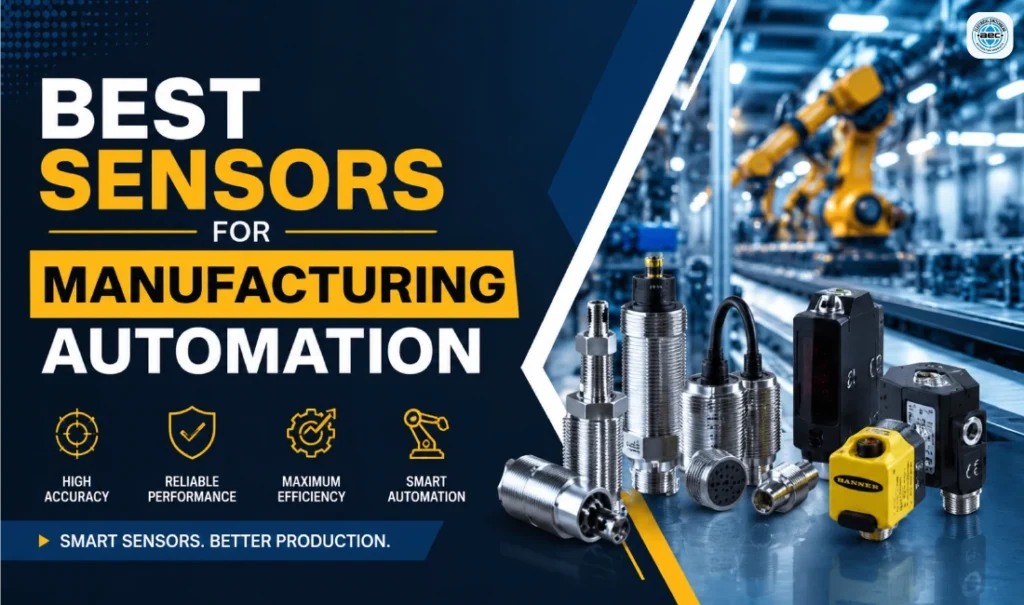
Industrial sensors are available in several technologies, and each type is designed to solve different sensing problems. There is no single sensor that is ideal for every industrial machine, which is why understanding the basic technologies is essential before making a purchase. Proximity sensors are commonly used for non-contact detection of metal objects, while photoelectric sensors can detect a wide range of objects using light. Temperature and pressure sensors are used when a machine needs to monitor process conditions rather than simply detect an object. Level sensors can help monitor liquids or materials inside tanks and containers, while motion and speed sensors can monitor rotating or moving machine components. Selecting the correct technology at the beginning can prevent compatibility problems and unnecessary replacement costs later.
The most common industrial sensor categories include:
- Inductive proximity sensors: Used mainly for non-contact detection of metallic objects.
- Photoelectric sensors: Use light to detect objects, presence, position, or movement.
- Capacitive sensors: Can detect a wider range of materials, including some liquids, powders, plastics, and non-metallic objects.
- Temperature sensors: Monitor heat and temperature changes in machinery and processes.
- Pressure sensors: Measure gas or liquid pressure in industrial systems.
- Level sensors: Detect or measure material and liquid levels.
- Ultrasonic sensors: Use sound waves for distance, level, or object detection.
- Motion and speed sensors: Monitor movement, rotation, and machine speed.
Aarcee Electrical Controls’ website also provides access to Omron sensor datasheets, including resources for E2B, E2E, E3FA, E3JK, E3Z and other industrial sensor families, which can be useful when comparing technical specifications before selecting a component.
How Do You Select the Right Sensor for an Industrial Machine?
The best way to select an industrial sensor is to start with the application rather than the product catalogue. First identify exactly what the machine needs to detect, measure, or monitor and then determine which sensing technology can perform that task reliably. The target material, required sensing distance, machine speed, available installation space, electrical supply, controller input, and environmental conditions should all be considered together. A sensor may appear suitable based on one specification but become unsuitable when other operating conditions are considered. Taking a systematic approach also makes it easier to compare products from different manufacturers and identify the most practical solution for the machine. Before purchasing, it is always advisable to verify the manufacturer’s datasheet and electrical specifications.
Use the following selection process:
- Identify the sensing requirement
Determine whether the machine needs object detection, position detection, temperature measurement, pressure monitoring, level sensing, motion detection, or another measurement. - Identify the target
Check whether the target is metal, plastic, glass, liquid, powder, wood, or another material. - Determine the sensing distance
Establish the actual distance between the sensor and the target during normal operation. - Check machine speed
High-speed production systems may require sensors with fast response times. - Check electrical compatibility
Confirm voltage, current, output type, wiring configuration, and PLC compatibility. - Evaluate the environment
Consider dust, water, oil, chemicals, temperature, vibration, and mechanical conditions. - Confirm mounting requirements
Check dimensions, thread size, connector type, cable arrangement, and available installation space. - Review long-term availability
Consider whether replacement units and technical documentation will be available when required.
What Sensor Specifications Should You Check Before Buying?
Industrial sensor datasheets contain numerous specifications, but not every specification has the same importance for every application. Buyers should focus on the parameters that directly affect the sensor’s ability to operate reliably in the machine. Sensing distance, supply voltage, output configuration, response time, environmental protection, operating temperature, and target characteristics are among the most important specifications. Physical dimensions and mounting requirements also matter because industrial machines often have limited space around moving components. Checking these specifications before ordering can prevent situations where a newly purchased sensor cannot communicate correctly with the existing controller or cannot be installed in the required position.
Important specifications to compare include:
Specification | What It Tells You |
Sensing technology | Determines how the target is detected |
Sensing distance | Shows the usable detection range |
Target material | Indicates what the sensor can reliably detect |
Supply voltage | Confirms electrical compatibility |
Output type | Determines how the sensor communicates with the controller |
Response time | Important for fast-moving applications |
IP rating | Indicates resistance to dust and moisture |
Operating temperature | Defines suitable temperature conditions |
Mounting type | Determines how the sensor can be installed |
Connector/cable | Affects installation and maintenance |
Sensor dimensions | Important when installation space is limited |
Always compare the actual manufacturer datasheet rather than relying only on a product title or short online description.
How Do Proximity Sensors Work in Industrial Automation?
Proximity sensors are among the most widely used sensing components in industrial automation because they can detect objects without physical contact. Inductive proximity sensors are particularly useful when a machine needs to detect metallic targets such as steel, iron, aluminium, or other conductive materials. Their non-contact operation reduces mechanical wear compared with physical switches that must touch the target. Proximity sensors can be installed on conveyors, assembly machines, packaging equipment, material handling systems, and automated production machinery. The exact sensor should be selected according to target material, sensing distance, mounting arrangement, output configuration, and environmental conditions. When properly selected and installed, proximity sensors can provide repeatable detection for automated machine sequences.
Typical proximity sensor applications include:
- Metal part detection
- Conveyor object detection
- Position confirmation
- Machine end-position detection
- Counting applications
- Component presence verification
- Automated assembly
- Machine sequencing
For applications requiring specific Omron sensing products, Aarcee Electrical Controls provides access to several Omron sensor datasheet resources through its website.
When Should You Use Photoelectric Sensors?
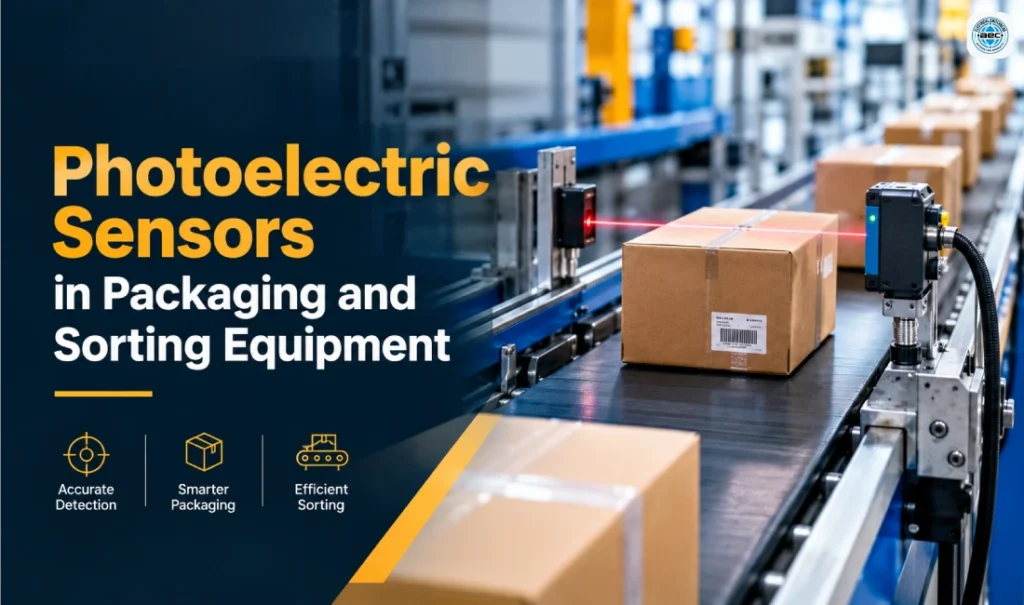
Photoelectric sensors are useful when an industrial machine needs to detect objects using light rather than physical contact. They can be suitable for many materials, including products that cannot be detected reliably using conventional inductive proximity sensing. Depending on the configuration, photoelectric sensors can detect objects over relatively long distances and can be used for conveyor systems, packaging machines, automated counting, product positioning, and material handling. Different photoelectric arrangements are available, including through-beam, retro-reflective, and diffuse-reflective configurations. The correct choice depends on the target’s size, colour, surface characteristics, distance, and the physical arrangement of the machine. Ambient light and reflective surfaces should also be considered during sensor selection.
Photoelectric sensors are commonly considered for:
- Product counting
- Packaging lines
- Conveyor systems
- Object presence detection
- Product positioning
- Bottle and container detection
- Automated inspection
- Material handling
For highly reflective, transparent, very small, or irregularly shaped targets, the sensor configuration should be selected carefully according to the manufacturer’s application guidance.
How Do Industrial Sensors Improve Machine Efficiency?
Sensors provide the information required for automated systems to make decisions quickly and consistently. Instead of relying on an operator to visually inspect every product or manually confirm every machine position, sensors can continuously monitor the process and send signals to the control system. This can improve production consistency and reduce repetitive manual tasks, especially in machines operating for long periods. Sensors can also provide feedback that allows a machine to stop, start, count, position, reject, or redirect products according to programmed logic. When combined with PLCs, relays, contactors, drives, switches, and other industrial control equipment, sensors become part of a complete automation architecture. Their contribution to efficiency therefore depends not only on the sensor itself but also on correct system design and integration.
Sensor-based automation can help businesses achieve:
- More consistent machine cycles
- Automated product detection
- Reduced manual inspection
- Improved production counting
- Faster machine response
- Better process repeatability
- Early identification of abnormal conditions
- Reduced operational errors
This is why sensor selection should be treated as a machine-design decision rather than simply a component-purchasing decision.
What Environmental Conditions Should You Consider?
Industrial environments can be significantly more demanding than offices, laboratories, or light-duty commercial spaces. Machines may operate around dust, oil, water, vibration, high temperatures, low temperatures, chemicals, metal particles, and continuous mechanical movement. A sensor that is not designed for those conditions may experience unreliable operation or a shortened service life. Environmental protection ratings, operating temperature, material construction, connector protection, cable quality, and installation position should therefore be reviewed before purchase. The sensor should also be positioned where it can perform its sensing function without being unnecessarily exposed to mechanical impact. Considering environmental conditions at the design stage can reduce maintenance issues later.
Before selecting a sensor, ask:
- Is the area dusty?
- Is water or coolant present?
- Will the sensor be exposed to oil?
- Are chemicals used nearby?
- What is the expected operating temperature?
- Is there significant vibration?
- Could the sensor be physically hit by machinery?
- Is electromagnetic interference a concern?
- Does the application require a particular IP rating?
These questions are particularly important for manufacturing plants, process industries, packaging facilities, and heavy industrial environments.
How Do Sensors Connect With PLCs and Industrial Control Systems?
A sensor becomes useful in an automated machine when its output can be correctly interpreted by the control system. Most industrial automation applications therefore require careful consideration of the relationship between the sensor, power supply, PLC input, relay, controller, and machine actuator. A sensor may provide a digital ON/OFF signal or an analogue signal depending on the application. Wiring configuration and output type must match the control system to ensure reliable operation. Incorrect voltage or incompatible outputs can result in a sensor that appears functional but does not provide the expected signal to the PLC. Proper wiring and commissioning are therefore just as important as selecting the sensor itself.
Before connecting a sensor, verify:
- Supply voltage
- Sensor current consumption
- PNP or NPN configuration
- Normally open or normally closed operation
- Digital or analogue output
- PLC input compatibility
- Cable and connector arrangement
- Grounding and wiring requirements
- Control-panel power supply capacity
Aarcee Electrical Controls also lists industrial power-supply products, including Omron S8VK-C series SMPS products, which are used in industrial control-panel applications.
How Are Sensors Related to LED Lighting Upgrade Cost?
Sensors are not limited to production machinery; they can also play an important role in automated industrial lighting. Motion sensors, occupancy sensors, daylight sensors, and other control devices can help lighting systems operate according to actual usage instead of remaining continuously switched on. This becomes relevant when a business calculates its LED Lighting Upgrade Cost, because the total project is not necessarily limited to the price of LED fixtures. Installation, electrical modifications, switching components, control equipment, sensors, wiring, and other requirements can all influence the final investment.
When evaluating LED Lighting Upgrade Cost, consider:
- Number of existing fixtures
- Replacement LED fixture type
- Lighting output requirements
- Electrical wiring modifications
- Installation labour
- Sensors and automatic controls
- Push buttons and control devices
- Switching equipment
- Existing electrical infrastructure
- Maintenance requirements
Aarcee Electrical Controls maintains an online category dedicated to LED & Push Buttons, with a range of industrial LED and push-button products available for applications requiring electrical indication and control. This means businesses considering an LED lighting upgrade can look at the complete control arrangement rather than considering lighting fixtures in isolation.
What Are the Most Common Sensor Selection Mistakes?
Many industrial sensor problems originate from incorrect selection rather than a defect in the sensor itself. One common mistake is choosing a component only because it is inexpensive or readily available without checking whether its technical specifications match the application. Another mistake is assuming that two sensors with similar physical dimensions will perform identically. Ignoring target material, sensing distance, environmental conditions, output configuration, or response speed can create problems after installation. Buyers may also overlook replacement availability, which can become important when a machine needs urgent maintenance. Taking a few additional minutes to review the datasheet can prevent costly troubleshooting later.
Common mistakes include:
- Choosing only by price
- Ignoring target material
- Selecting insufficient sensing distance
- Forgetting environmental conditions
- Using an incompatible output type
- Ignoring response time
- Not checking mounting dimensions
- Overlooking replacement availability
- Buying without reviewing the manufacturer’s datasheet
A reliable selection process should always start with the machine requirement and end with technical specification verification.
Why Choose Aarcee Electrical Controls for Industrial Electrical and Automation Products?
Choosing a reliable supplier can make the purchasing process easier because industrial customers often need more than a product catalogue. Technical specifications, genuine products, availability, replacement support, brand selection, and timely supply can all influence an automation project. Aarcee Electrical Controls was established in 2006 and operates from Kundli, Haryana, serving manufacturing units, OEMs, automation integrators, and infrastructure projects. The company states that it maintains a wide inventory of industrial components and focuses on product quality, authenticity, technical knowledge, and customer service. Its website currently highlights more than 1,000 active products and more than 2,000 customers.
Aarcee Electrical Controls offers products and resources across areas such as:
- Industrial electrical products
- Control gear
- Automation products
- LED and push-button products
- Industrial power supplies
- Omron automation components
- Electrical control products
- Industrial datasheets and technical resources
The company lists brands including BCH Electric, KEI Industries, Omron Automation, Rishabh Instruments, Salzer Electronics, and Socomec. Businesses can explore the Aarcee Electrical Controls website to review available industrial electrical and automation product categories.
What Should You Check Before Ordering an Industrial Sensor?
Before placing an order, it is worth creating a short technical checklist based on the actual machine application. This helps purchasing teams, maintenance engineers, OEMs, and automation integrators communicate the requirement clearly and avoid selecting a component based on incomplete information. The more accurately the application is defined, the easier it becomes to compare suitable products. If the sensor is replacing an existing component, recording the old sensor’s part number, voltage, output type, sensing distance, and physical dimensions can also make replacement easier. When there is uncertainty, checking the manufacturer’s datasheet or consulting an experienced industrial electrical supplier is preferable to making an assumption.
Before ordering, confirm:
- What does the sensor need to detect?
- What material is the target?
- What sensing distance is required?
- What is the machine’s operating speed?
- What supply voltage is available?
- What output does the PLC require?
- What environmental conditions exist?
- What mounting arrangement is required?
- What connector or cable is needed?
- Is the product available for future replacement?
- Is the manufacturer’s datasheet available?
- Does the selected product meet the machine’s actual requirements?
A proper checklist can significantly reduce the risk of selecting the wrong component.
Final Thoughts on Selecting Sensors for Industrial Machines
Selecting the right industrial sensor is an important part of designing a reliable and efficient automated machine. The correct decision starts by understanding what needs to be detected and then matching the sensing technology to the target material, sensing distance, machine speed, electrical system, environmental conditions, and installation requirements. A sensor should never be selected only because it has a lower purchase price or looks similar to an existing component. Technical compatibility and long-term reliability are much more important for industrial applications. For manufacturers, OEMs, maintenance teams, automation integrators, and industrial buyers, a structured selection process can make sensor purchasing much easier. Reviewing datasheets, checking electrical specifications, confirming environmental requirements, and considering future replacement availability can help prevent unnecessary machine interruptions. Sensors also become more valuable when integrated correctly with PLCs, power supplies, relays, control gear, and other automation components. If your project also involves industrial lighting, remember that LED Lighting Upgrade Cost should be evaluated as part of the complete electrical system. LED fixtures, sensors, push buttons, switching equipment, wiring, and control components may all contribute to the final project requirement. For industrial electrical, control gear, automation products, LED and push-button solutions, and related components, businesses can explore Aarcee Electrical Controls at aarceeelectrical.com. With a product portfolio covering industrial electrical and automation requirements and technical resources for several Omron product families, Aarcee Electrical Controls can be a useful sourcing partner for businesses working on industrial automation and electrical projects.
FAQs
Have questions? We’ve answered some of the most common queries to help you understand the topic better.
Q1. What is the best sensor for industrial machines?
There is no single best sensor for every machine. Inductive proximity sensors, photoelectric sensors, capacitive sensors, temperature sensors, pressure sensors, ultrasonic sensors, and other technologies are suitable for different applications.
Q2. Which sensor is best for detecting metal objects?
An inductive proximity sensor is commonly used for non-contact metal detection. The exact model should be selected according to target material, sensing distance, mounting arrangement, voltage, output type, and environmental conditions.
Q3. What should I check before buying a proximity sensor?
Check the sensing distance, target material, supply voltage, output configuration, response time, mounting style, environmental protection, operating temperature, cable or connector type, and physical dimensions.
Q4. Can sensors reduce industrial machine downtime?
Properly selected sensors can contribute to more reliable automation by providing consistent detection and feedback. However, overall machine reliability also depends on correct wiring, control logic, mechanical design, maintenance, and other components.
Q5. Can sensors be used with industrial LED lighting?
Yes. Motion, occupancy, and other sensing technologies can be integrated with lighting controls to automate when industrial lighting operates. This can be considered when planning an LED lighting upgrade.