Understanding Temperature Controllers: Types, Working and Applications


Temperature plays an important role in industrial manufacturing, electrical systems, food processing, packaging, HVAC equipment, and many other applications. Even a small temperature variation can affect product quality, equipment performance, energy consumption, and production efficiency. This is why Temperature Controllers are widely used in industrial automation to maintain the required temperature and ensure consistent operating conditions. A temperature controller measures the actual temperature through a connected sensor, compares it with a predefined target, and controls the heating or cooling equipment accordingly. Depending on the application, it may use simple ON/OFF switching or advanced PID control to maintain temperature within an acceptable range. These devices are particularly useful in industrial processes where manual temperature adjustment is time-consuming or unreliable. Understanding how Temperature Controllers work helps businesses select the right equipment for their specific requirements. Factors such as temperature range, sensor compatibility, control accuracy, output type, and installation conditions all influence performance. In this guide, we will explore temperature controller working principles, types, industrial applications, benefits, and important selection considerations.
What Are Temperature Controllers and How Do They Work?
Temperature Controllers are electronic instruments designed to monitor and regulate the temperature of a system according to a predefined setpoint. They help maintain the desired temperature by continuously receiving information from a sensor and adjusting the operation of compatible heating or cooling equipment. Unlike a temperature indicator that simply displays a reading, a temperature controller can automatically respond when the measured temperature differs from the required value. The working process begins with a temperature sensor that measures the temperature of a machine, liquid, heating chamber, production material, or surrounding environment. Common sensors include thermocouples and resistance temperature detectors (RTDs). These sensors convert temperature changes into electrical signals that the controller can interpret. The controller compares the measured temperature, known as the process variable, with the programmed setpoint and determines whether corrective action is necessary. For example, consider an industrial oven that must maintain a temperature of 150°C. If the sensor detects that the temperature has fallen below the setpoint, the controller activates or increases the heating output. As the oven approaches the required temperature, the controller reduces or stops the heating output according to its control settings. In a cooling application, the controller can operate compatible cooling equipment when the temperature rises above the desired level. This feedback process continues as operating conditions change. Production loads, ambient temperature, equipment usage, and material movement can all influence the actual temperature. By responding to these changes, Temperature Controllers help maintain more consistent conditions and reduce the need for constant manual supervision. A complete temperature control system generally includes a sensor, controller, output device, and heating or cooling equipment. The output device may be a relay, solid-state relay (SSR), contactor, power controller, or compatible valve, depending on the system design. Each component must be properly matched to the electrical and operational requirements of the application. Modern digital temperature controllers may also include readable displays, adjustable setpoints, alarm functions, sensor fault indications, and communication interfaces. These features can help operators monitor the process and identify abnormal conditions. However, performance depends on correct installation, suitable sensor placement, proper configuration, and regular maintenance. Businesses looking for temperature control equipment can explore the Temperature Controller product category at Aarcee Electrical to review the available category and identify options that may suit their requirements.
What Are the Main Types of Temperature Controllers?
Different industrial processes require different levels of temperature accuracy and control. Some applications can operate with minor temperature fluctuations, while others need precise regulation to maintain product quality and process stability. Temperature Controllers are therefore available with different control methods, allowing users to choose an option based on the equipment, operating conditions, and acceptable temperature variation. ON/OFF temperature controllers are among the simplest types. They switch the heating or cooling output on or off according to the measured temperature and setpoint. In a heating application, the controller activates the heater when the temperature falls below the switching threshold and turns it off when the temperature reaches the required level. Many models use a small switching differential, called hysteresis, to reduce rapid switching near the setpoint. ON/OFF control is commonly suitable for basic applications where a small amount of temperature variation is acceptable. Proportional temperature controllers adjust their output according to the difference between the measured temperature and the setpoint. As the temperature approaches the target, the controller reduces the output rather than relying entirely on full-power switching. This can improve temperature stability in suitable applications, although proportional control alone may leave a small steady-state error. PID temperature controllers use three control actions: proportional, integral, and derivative. Proportional control responds to the current temperature error, integral control addresses accumulated error over time, and derivative control responds to changes in the error. When configured correctly, PID control can help maintain a more stable temperature in processes affected by changing loads or requiring tighter control. Digital temperature controllers use electronic processing and digital displays to manage temperature settings and control functions. Depending on the model, they may support ON/OFF or PID control, alarm outputs, automatic tuning, multiple control modes, and communication with industrial automation systems. Digital operation does not automatically mean that a controller is more accurate; the actual performance depends on its specifications and the complete control system.
The main differences between common control methods are summarised below.
Feature | ON/OFF Control | PID Control |
Operating method | Switches output on or off | Calculates a corrective output |
Configuration | Generally simple | May require tuning |
Temperature stability | Suitable for basic applications | Can provide tighter control when configured correctly |
Typical use | Basic heating and cooling | Precision heating and industrial processes |
The right controller depends on the temperature tolerance, response speed, equipment design, and operating conditions. A simple heater may work effectively with ON/OFF control, while a plastic processing machine or industrial oven may require PID regulation. Selecting a more advanced controller is not always necessary; the goal is to choose a control method that meets the actual process requirements. For further technical information, refer to OMRON’s guide to temperature controllers and control principles.
What Are the Industrial Applications and Benefits of Temperature Controllers?
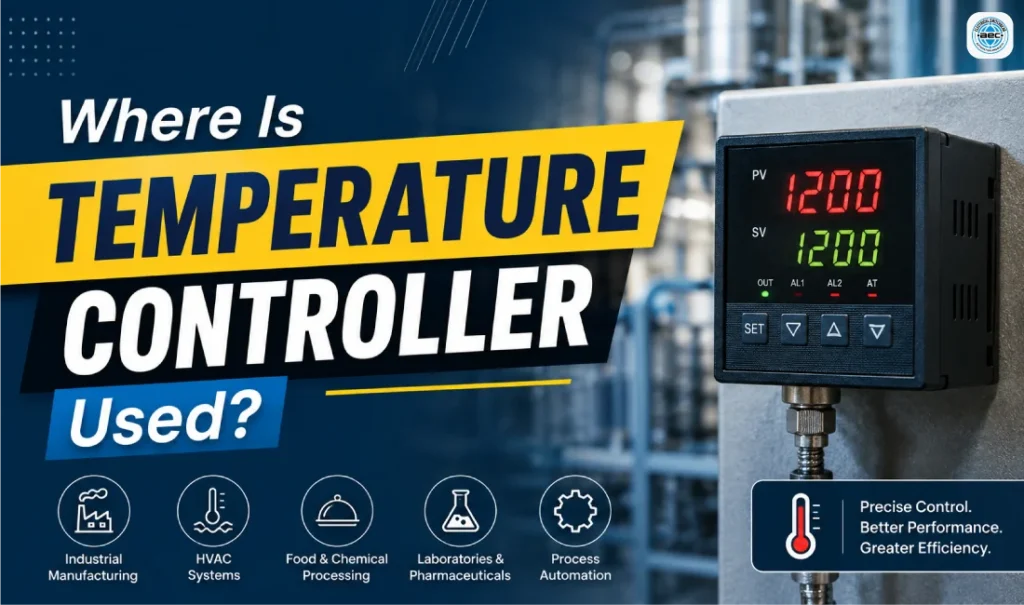
Temperature Controllers are used in industries where maintaining a defined temperature is essential for reliable operation, consistent production, and equipment protection. Their applications range from basic heating systems to complex manufacturing processes in which temperature affects material properties, product quality, or operating efficiency. By automating temperature regulation, these devices help businesses maintain more predictable conditions across different production cycles. In manufacturing plants, temperature controllers are used in industrial ovens, furnaces, heat treatment equipment, plastic moulding machines, and other temperature-dependent production systems. In plastic processing, for example, maintaining the correct temperature helps control material flow and product consistency. In industrial heating chambers, accurate temperature regulation supports repeatable processing conditions and can reduce quality variations caused by excessive heating or insufficient temperature. Food processing and packaging operations may use temperature control equipment in heating systems, sealing machines, refrigeration units, and temperature-sensitive production processes. Maintaining suitable temperatures can improve process consistency, although food safety requirements still demand appropriate monitoring, validated procedures, and other necessary controls. A temperature controller should be selected according to the specific equipment and the conditions in which it operates. Temperature Controllers are also used in HVAC systems, refrigeration equipment, water heating systems, laboratory instruments, and electrical enclosures. In HVAC applications, they can help regulate heating or cooling equipment to maintain the desired environmental conditions. In laboratories, suitable controllers support repeatable temperature conditions for testing and measurement. Their role varies according to the system, but the objective remains the same: to measure temperature and respond automatically when conditions change. One of the major benefits of temperature controllers is improved process consistency. Automatic regulation helps keep equipment closer to the desired temperature, reducing fluctuations that may affect product quality or production results. In suitable applications, this can reduce rework, material wastage, and interruptions caused by inconsistent operating conditions. Another benefit is reduced dependence on manual adjustment. Operators can monitor the process and respond to alarms instead of repeatedly switching equipment on and off. Digital displays and diagnostic functions may also help maintenance teams identify abnormal readings, sensor faults, or control problems more quickly. Proper temperature regulation may contribute to energy efficiency by preventing unnecessary heating or cooling. However, actual energy savings depend on equipment efficiency, insulation, process loads, operating schedules, and controller settings. Temperature Controllers are most effective when selected and integrated correctly with compatible sensors, output devices, and heating or cooling equipment.
How to Choose the Right Temperature Controllers for Your Application
Choosing the right Temperature Controllers begins with understanding the requirements of the process. Before comparing products, identify the minimum and maximum operating temperatures, the acceptable variation around the setpoint, the type of heating or cooling equipment, and how quickly the system responds to temperature changes. These details help determine the required controller specifications and avoid compatibility problems during installation. The first consideration is sensor compatibility. The controller must support the sensor used in the application, such as the specified thermocouple type or RTD configuration. Different sensors have different operating ranges and electrical characteristics, so an incompatible input can result in incorrect readings. Sensor accuracy, response time, installation position, and environmental suitability should also be considered. Next, evaluate the required control method. ON/OFF control may be sufficient for applications that tolerate some temperature variation, while PID control may be more appropriate when tighter regulation is needed. Consider whether functions such as alarms, automatic tuning, multiple setpoints, heating and cooling modes, or communication interfaces are necessary. Choosing features based on actual requirements helps avoid unnecessary complexity. Output compatibility is equally important. Temperature controllers may provide relay outputs, SSR drive outputs, analogue signals, or other interfaces. Check the electrical ratings and switching limitations before connecting the controller to a heater, compressor, contactor, or other load. Some applications require an external switching device rather than connecting the load directly to the controller. Installation conditions should also influence the selection. Verify the supply voltage, panel dimensions, mounting arrangement, ambient operating temperature, enclosure requirements, and compatibility with the existing control panel. If the system communicates with a programmable logic controller (PLC) or supervisory control and data acquisition (SCADA) system, confirm that the required communication interface is supported. Finally, review the product documentation and consider long-term maintenance, technical support, and overall suitability. The cheapest controller may not be the most appropriate choice if it lacks the necessary inputs, output ratings, or control functions. A suitable product should meet the process requirements while remaining practical to install, operate, and maintain. Aarcee Electrical’s Temperature Controller product category is a useful starting point for exploring available options. Review individual product specifications and confirm that the selected model matches your application’s technical requirements before purchasing.
How to Maintain Temperature Controllers for Reliable Performance
Regular inspection and maintenance help keep Temperature Controllers operating reliably and make it easier to identify problems before they cause production interruptions. Although the controller itself may require limited routine attention, the sensor, wiring, output hardware, and heating or cooling equipment must all work correctly for the complete system to maintain its required temperature. One common issue is an inaccurate temperature reading. This may be caused by a damaged sensor, incorrect input configuration, loose connections, poor sensor placement, or calibration problems. Compare readings with an appropriate reference instrument when required, and check that the controller is configured for the installed sensor. Follow the manufacturer’s instructions when inspecting or replacing components. Unstable temperature regulation may occur when the control method is unsuitable, PID settings are poorly tuned, or the process responds slowly to heating or cooling. Sensor placement can also cause problems if it does not represent the temperature of the area being controlled. Reviewing the installation, controller settings, and system behaviour can help identify the cause. Output faults may result from damaged relays, incompatible switching devices, overloaded outputs, loose wiring, or faulty heating elements. Electrical inspections and repairs should be carried out by qualified personnel after the equipment has been safely isolated. Never assume that a temperature controller alone provides all the safety protection required by a process. Preventive maintenance should include inspecting sensor condition, checking wiring and terminals, verifying alarm operation, reviewing settings, and following the recommended calibration schedule. Keeping records of recurring faults and unusual temperature variations can help maintenance teams identify patterns and improve reliability.
Conclusion
Temperature Controllers are essential components in industrial automation because they help maintain required temperature conditions, improve production consistency, and reduce the need for constant manual adjustments. Understanding their working principles, control methods, applications, and selection criteria makes it easier to choose the right equipment for different industrial environments. Whether an application requires simple ON/OFF switching or more advanced PID regulation, the controller must be compatible with the sensor, output device, and process requirements. Proper installation, configuration, and maintenance are equally important for reliable performance. To explore temperature control equipment for your industrial or commercial requirements, visit Aarcee Electrical’s Temperature Controller category and review the available product specifications before making your selection.
FAQs
Have questions? We’ve answered some of the most common queries to help you understand the topic better.
Q1. What is a temperature controller?
A temperature controller measures temperature, compares it with a setpoint, and regulates compatible heating or cooling equipment.
Q2. Which temperature controller is best for industrial use?
ON/OFF controllers suit basic applications, while PID controllers are often preferred for tighter temperature regulation.
Q3. What is the difference between a temperature sensor and a controller?
A sensor measures temperature, while a controller uses that measurement to determine the required control action.
Q4. Can temperature controllers save energy?
They may reduce unnecessary heating or cooling when properly selected and configured, but actual savings depend on the complete system.
Q5. Where can I find temperature controllers from Aarcee Electrical?
Visit the Aarcee Electrical Temperature Controller category to explore the available options.