
What Are Rotary Encoders? Construction & Working

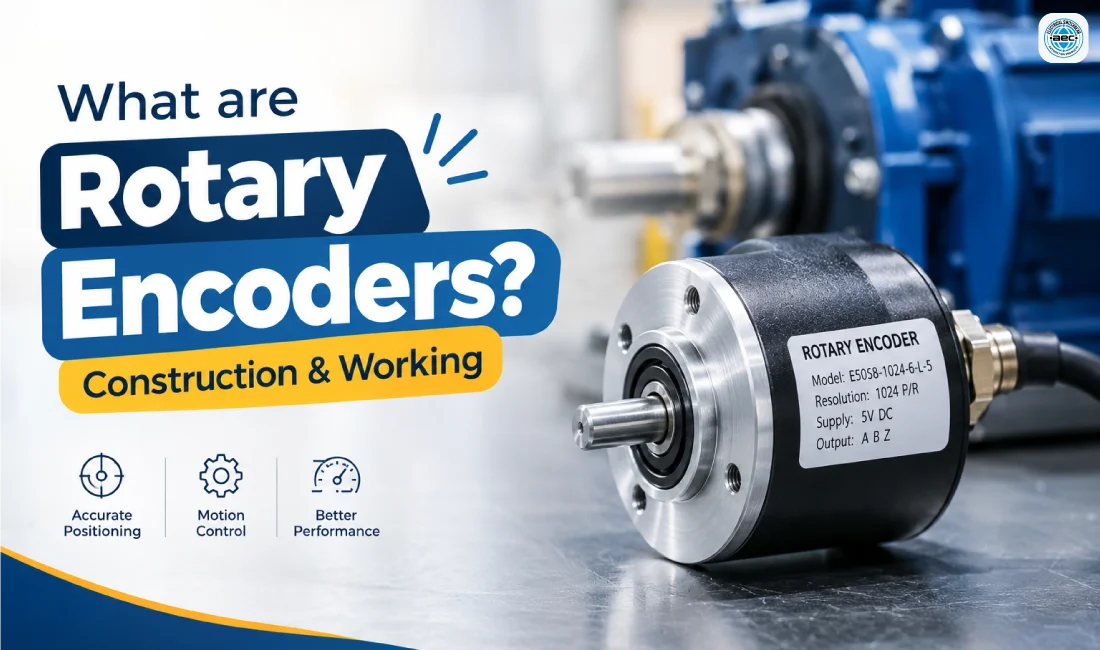
Introduction
Industrial automation depends on accurate movement, reliable feedback, and precise control of machinery. From conveyor systems and packaging machines to CNC equipment and robotic arms, industries require dependable ways to measure the movement of rotating components. This is where Rotary Encoders play an important role. These devices convert mechanical rotation into electrical signals that industrial controllers can interpret to measure speed, direction, and position. By providing motion feedback, Rotary Encoders help machines perform repetitive tasks more consistently and support accurate control of motors and automated equipment. They are widely used in manufacturing plants, production lines, material-handling systems, and other industrial applications where controlled movement is essential. Understanding rotary encoder construction, working principles, types, and applications helps engineers, maintenance professionals, and industrial buyers choose the right product for their requirements. In this guide, we explain how Rotary Encoders work, their main types, their advantages, and the factors to consider when selecting an encoder for industrial automation.
What Are Rotary Encoders and How Do They Work?
Rotary Encoders are electromechanical or electronic sensing devices that detect the rotation of a shaft and convert it into electrical signals. These signals represent movement, rotational speed, direction, or angular position, depending on the encoder design and the connected control system. A rotary encoder is commonly mounted on a motor shaft, conveyor roller, or rotating machine component to provide feedback about its movement. The generated signals are transmitted to equipment such as a programmable logic controller (PLC), servo drive, counter, or motion controller, which processes the information and uses it to monitor or control machine operations. For example, a conveyor system can use encoder feedback to estimate how far a belt has travelled and determine when a product reaches a specified position. Similarly, a motor-control system can use encoder signals to measure speed and adjust operation when required. Rotary Encoders are also known as rotary position sensors or shaft encoders, and their capabilities depend on the technology and specifications of the selected model. The working principle of Rotary Encoders involves detecting changes in a rotating element and converting those changes into electrical output signals. In an optical encoder, a light source illuminates a coded disc containing transparent and opaque sections, while a detector senses changes in light as the disc rotates. In a magnetic encoder, a sensor detects changes in the magnetic field generated by a rotating magnetic element. The encoder’s electronic circuitry processes these changes and produces signals that a compatible controller can interpret. Incremental encoders generally generate pulses representing changes in movement, while absolute encoders provide a coded value corresponding to the shaft’s angular position. A controller can use incremental pulses to calculate speed by measuring the number of pulses received over a specific period. With suitable output channels, it can also determine the direction of rotation. In a positioning application, the controller can compare the measured movement or position with the required value and adjust machine operation according to its control strategy. The construction of Rotary Encoders typically includes a shaft or rotating element, a sensing disc or magnetic target, a detector, signal-processing electronics, an output interface, and a protective housing. The shaft transfers mechanical movement to the sensing mechanism, while the detector identifies changes caused by rotation. Internal electronics convert the detected changes into usable electrical signals, which travel to the connected automation equipment through wires, connectors, or supported communication interfaces. The housing protects the internal components according to the product’s specified environmental rating. Depending on the application, encoders may have solid shafts, hollow shafts, different mounting arrangements, and different output configurations. Correct mounting and alignment are essential because excessive vibration, mechanical stress, or unsuitable coupling can affect performance. When choosing Rotary Encoders, engineers should consider the mechanical construction and electrical interface alongside the required measurement accuracy to ensure compatibility with the complete machine.
Types of Rotary Encoders and Their Applications
Rotary Encoders are available in different types to meet the requirements of industrial motion control, position measurement, and speed monitoring. The two main types are incremental and absolute encoders, which differ in how they represent shaft movement and position. Incremental encoders generate electrical pulses as the shaft rotates, allowing a controller to calculate movement and rotational speed by counting those pulses. Many models use two output channels, commonly called A and B, that are offset in phase to help determine the direction of rotation. Some also include an index channel that provides a reference pulse at a defined point in each revolution. Incremental Rotary Encoders are commonly used in conveyor systems, motor speed monitoring, packaging machinery, and applications where relative movement is sufficient. However, because position is tracked through accumulated counts, the system may need a homing procedure after startup or loss of the position count. Absolute Rotary Encoders provide a digital value representing the shaft’s current position within their specified measuring range. Unlike incremental models, they do not rely solely on counting pulses from a reference point to identify position. This makes them useful in applications where the machine needs to know the current position after restarting, such as robotic joints, rotary indexing tables, and precision positioning equipment. Absolute encoders are available in single-turn and multi-turn designs. Single-turn models identify the position within one revolution, while multi-turn models also track the number of revolutions within their specified range. The way multi-turn position is retained depends on the encoder’s design and may involve electronic, mechanical, battery-assisted, or other supported technologies. Although absolute encoders can simplify certain positioning requirements, buyers should also consider their communication interface, resolution, configuration, and cost before selecting a model for a particular machine. Optical and magnetic Rotary Encoders are two common sensing technologies used in industrial applications. Optical encoders use light and a coded disc to detect rotation, making them suitable for applications that require detailed motion feedback and high resolution. Magnetic encoders use a magnetic target and sensing elements to detect changes in the magnetic field. Depending on the design, magnetic models may be suitable for certain environments where dust, vibration, or contamination could affect other sensing arrangements. However, neither technology is automatically suitable for every industrial condition, so operating temperature, environmental protection, resolution, rotational speed, and electromagnetic interference must be evaluated against the manufacturer’s specifications. The choice between incremental, absolute, optical, and magnetic encoders should depend on the machine’s measurement requirements rather than on the type name alone. Rotary Encoders are used in a wide range of industrial applications because accurate motion feedback supports consistent and controlled machine operation. In conveyor systems, encoders help track movement and coordinate product handling. In CNC machines and servo motor systems, compatible encoders provide feedback for speed or position control. Packaging and labelling machinery uses encoder signals to coordinate feeding, cutting, filling, and printing operations. Robotics and automated handling equipment use position feedback to monitor joint movement and support repeatable motion. Industrial winding systems may also use encoders to monitor the rotation of equipment handling cables, films, or other materials. In each application, the encoder operates as part of a larger control system, so its performance depends on suitable installation, compatible electronics, mechanical alignment, and correct programming.
Benefits of Rotary Encoders and How to Choose the Right One
Rotary Encoders provide important benefits for industrial automation by giving control systems measurable information about rotating components. This feedback helps compatible controllers monitor actual movement rather than relying only on commands sent to a motor. In applications that require repeatable positioning, controlled speed, or coordination between moving machine parts, encoder signals can support more consistent operation. Different resolutions and output configurations allow engineers to select devices for applications ranging from basic speed measurement to precision motion control. Encoder feedback can also help maintenance teams investigate unexpected movement or differences between commanded and measured positions. When incorporated into a suitable monitoring system, this information may support troubleshooting and maintenance planning. However, an encoder alone cannot guarantee accuracy or prevent machine faults, because mechanical backlash, coupling alignment, electrical noise, controller settings, and other components also influence the overall performance of the system. Choosing the right Rotary Encoders begins with identifying the required measurement. If the application needs speed monitoring or relative movement, an incremental encoder may be suitable. If the machine needs direct position information after startup, an absolute encoder may be a better option. The required resolution must match the smallest movement the system needs to detect and the processing capability of the connected controller. Incremental encoder resolution is commonly described in pulses per revolution (PPR) or cycles per revolution (CPR), although manufacturers may define these terms differently. Absolute encoder resolution may be specified in bits or distinct positions per revolution. Buyers should also check the supply voltage, output type, signal levels, wiring arrangement, connector, and compatibility with the PLC or drive. Confirming these details before purchasing helps prevent compatibility problems during installation. Mechanical and environmental requirements are equally important when selecting Rotary Encoders for industrial use. Check the shaft diameter, mounting style, coupling requirements, allowable shaft loading, maximum rotational speed, and available installation space. The encoder must also suit the operating environment, including temperature, dust, moisture, vibration, oil exposure, and possible electrical interference. Where the machine operates under demanding conditions, review the product’s ingress-protection rating and the manufacturer’s installation instructions rather than assuming all industrial encoders offer the same protection. It is also important to verify the exact model number and technical datasheet, because encoders with similar appearances can have different resolutions, output configurations, and electrical requirements. Careful comparison of these specifications helps industrial buyers select an encoder that meets the machine’s actual requirements. Businesses looking for industrial encoder options can explore the Rotary Encoders product category at Aarcee Electrical Controls. The category provides a starting point for reviewing available models and comparing their specifications with the requirements of motors, conveyors, packaging equipment, and other automated machinery. Buyers should confirm each model’s resolution, electrical interface, supply requirements, and mounting arrangement before ordering. For additional industrial electrical and automation products, visit the Aarcee Electrical Controls website. Selecting a compatible product based on verified technical specifications can help engineers, maintenance teams, and machine manufacturers make informed purchasing decisions and integrate encoder feedback more effectively into their automation systems.
Conclusion
Rotary Encoders are important components in industrial automation because they convert mechanical rotation into electrical feedback that helps controllers monitor movement and position. Their construction combines a sensing mechanism, rotating element, electronic circuitry, output interface, and protective housing. Understanding the working principles of incremental, absolute, optical, and magnetic encoders makes it easier to identify a suitable device for different industrial applications. Before selecting an encoder, consider the required resolution, electrical compatibility, mechanical mounting, operating speed, and environmental conditions. A correctly selected and installed encoder can support consistent machine operation, accurate movement monitoring, and effective motion control. To explore available options for your application, visit the Aarcee Electrical Controls Rotary Encoders category and review the specifications of the relevant models.
FAQs
Have questions? We’ve answered some of the most common queries to help you understand the topic better.
Q1. What is the main function of Rotary Encoders?
Rotary Encoders convert shaft rotation into electrical signals used to measure speed, direction, movement, or position.
Q2. What are the main types of Rotary Encoders?
The main types are incremental and absolute encoders. Optical and magnetic encoders are classified by their sensing technology.
Q3. How do Rotary Encoders measure speed?
They generate signals as the shaft rotates, allowing a controller to calculate speed from the number of pulses received over time.
Q4. Where are Rotary Encoders used?
They are used in conveyors, CNC machines, robotics, servo motors, packaging equipment, and industrial automation systems.
Q5. How do I choose the right rotary encoder?
Check the required resolution, output type, supply voltage, mounting, rotational speed, environmental conditions, and controller compatibility.