How Safety Relays Work

Industrial machines are designed to improve production speed, accuracy and efficiency, but many of them also contain moving parts, electrical equipment and mechanical systems that can create serious hazards. A reliable machine safety system helps protect operators, maintenance teams and equipment when an unexpected situation occurs. Safety relays are an important part of this system because they monitor safety devices and help stop hazardous machine functions when a safety condition is triggered. Unlike a conventional relay that mainly performs an electrical switching function, a safety relay is designed to monitor safety circuits and identify certain faults that could affect the safety function. It can work with emergency stop buttons, safety gates, light curtains, two-hand controls and other protective devices. Many safety relay systems also use dual-channel circuits, monitored reset functions and feedback from external contactors. Understanding how safety relays work is useful for machine builders, electrical engineers, automation professionals, maintenance teams and industries using automated equipment. The following guide explains the complete working principle of safety relays, their important features, applications and selection considerations in simple and practical terms.
What Are Safety Relays and How Do They Work?
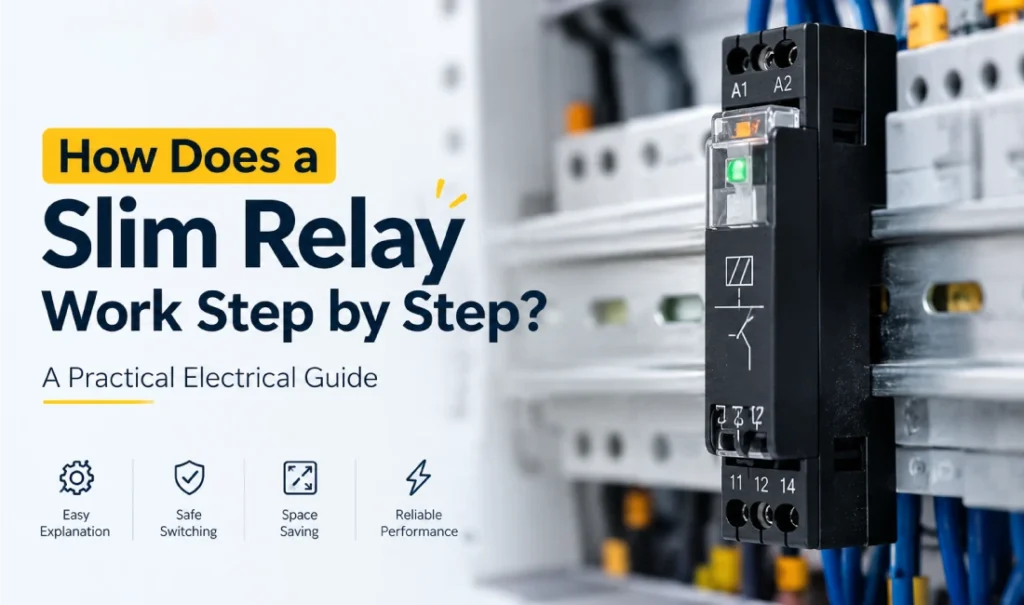
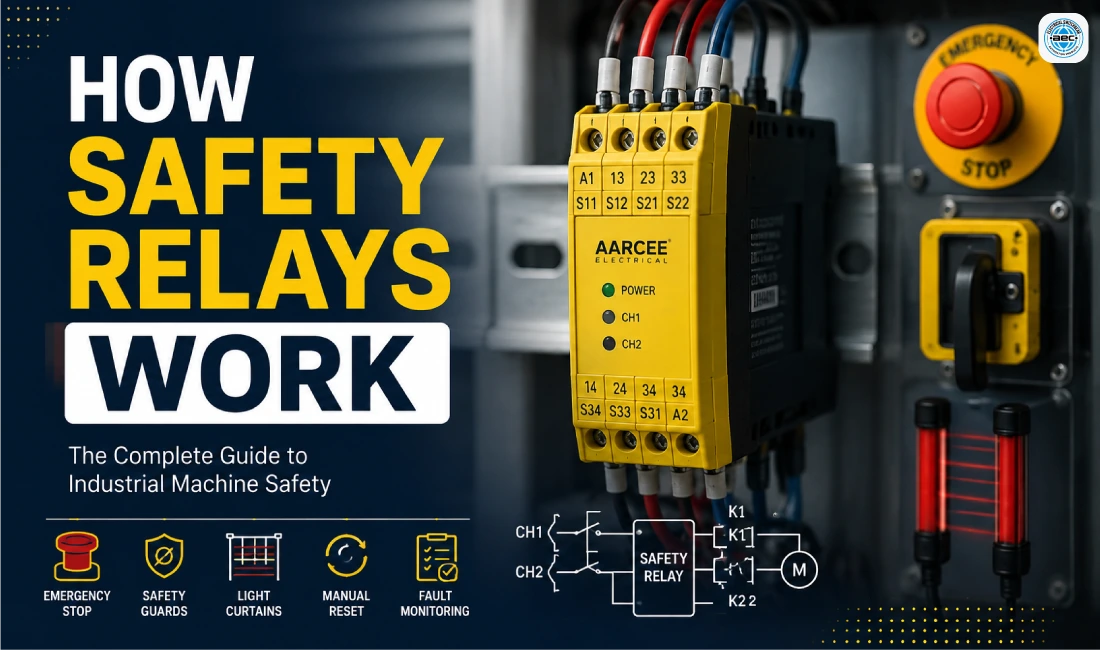
A safety relay is a specialized control device used to monitor safety-related input devices and control the safe shutdown or operation of industrial machinery. It is normally installed between safety devices such as emergency stops, guard switches or light curtains and the machine’s final switching devices, such as contactors. Its purpose is to ensure that the machine can operate only when the required safety conditions are satisfied. The basic operation starts when the safety relay receives signals from connected safety devices. When all required inputs are in their normal safe state, the relay evaluates the circuit and, if the system is healthy, permits its safety outputs to operate. These outputs can then control contactors or other components responsible for controlling hazardous machine energy. If an operator presses an emergency stop, opens a monitored safety guard or interrupts a light curtain, the safety input changes state. The safety relay detects this change and de-energizes its safety outputs. The connected contactors can then drop out, helping bring the machine to its defined safe condition. Many modern industrial safety relays use two independent input channels rather than relying on a single wire or contact. Both channels are monitored to help detect certain faults, such as an unexpected difference between the two signal paths. This provides a greater level of diagnostic capability than a basic single-channel control circuit. Safety relays can also monitor external contactors through an External Device Monitoring (EDM) or feedback circuit. Auxiliary contacts from the contactors provide information about whether they have actually returned to their expected state. If a contactor remains stuck or welded, the safety relay can prevent the machine from being reset until the problem is corrected. Another important function is manual reset. After a safety device has been activated, releasing the emergency stop or closing a machine guard does not necessarily restart the machine. A separate reset operation can be required after the relay has verified that the safety circuit and feedback conditions are correct. For businesses searching for industrial electrical and automation components, Aarcee Electrical provides a dedicated range of safety-related products. You can explore the Safety Relays product category from Aarcee Electrical for products suitable for different industrial safety control requirements.
Why Do Safety Relays Use Dual-Channel Monitoring and Fault Detection?
One of the most important differences between safety relays and ordinary control relays is their ability to monitor safety circuits for certain faults. A safety system should not simply assume that everything is safe because one electrical signal appears normal. Dual-channel monitoring provides two separate signal paths that can be evaluated by the safety relay. A common example is an emergency stop button with two normally closed safety contacts. Each contact is connected to a separate input channel. During normal operation, both channels indicate that the emergency stop circuit is healthy. When the emergency stop is pressed, both channels change state and the relay removes its safety outputs. The two-channel arrangement is also useful for detecting certain wiring or contact failures. If one channel changes while the other remains in an unexpected state, the relay may recognize the mismatch and prevent the safety outputs from being energized. The exact fault-detection capability depends on the particular relay and wiring configuration. Another important feature found in many safety relay modules is the use of force-guided or mechanically linked contacts. These contacts are designed so that their mechanical relationship helps the monitoring system identify certain contact-welding conditions. This is important because a welded relay contact could otherwise create an incorrect indication of the machine’s safety status. External Device Monitoring provides another layer of protection. In a typical machine, safety relay outputs may control two contactors that disconnect hazardous power. Auxiliary normally closed contacts from those contactors can be connected back to the safety relay. When the machine enters a safety stop, the relay expects the contactors to return to their safe state. If one contactor remains closed because its contacts have welded or its mechanism has failed, the feedback circuit can indicate that the expected condition has not been achieved. Depending on the system design, the safety relay can then prevent a reset or restart. This helps ensure that the machine is not treated as ready while an important safety component remains faulty. These features make machine safety relays particularly useful in industrial automation. However, they do not make a machine automatically safe on their own. Correct component selection, wiring, installation, validation, testing and maintenance are all necessary parts of a complete machine safety system.
What Happens When an Emergency Stop or Safety Device Is Activated?
Emergency stop monitoring is one of the most common applications of safety relays. The relay provides an interface between the emergency stop circuit and the machine’s safety outputs, allowing the machine to respond when an operator activates the emergency stop or another protective device detects a hazardous condition. When an emergency stop button is pressed, its safety contacts change state. The safety relay detects the interruption through its monitored input channels and changes the state of its safety outputs. If these outputs control machine contactors, the contactors can de-energize and disconnect the relevant machine power or control circuit. The same basic principle can be used with safety gates and guards. A guard switch can be installed so that opening a protective door interrupts the safety circuit. The safety relay detects the change and prevents or stops the relevant hazardous machine function. Light curtains can provide another safety input. They are commonly installed around presses, automated production equipment and other machinery where operators need access to a protected area. If the light curtain detects an interruption, its safety output changes and the safety relay responds according to the configured safety function. Two-hand controls are another example. In applications where simultaneous operation of two controls is required, a suitable safety relay can evaluate the inputs before allowing the machine cycle to begin. This can help reduce the possibility of an operator placing their hands in a hazardous area during machine operation. After a safety event, a manual reset can be used to prevent unintended restarting. The operator may need to release the emergency stop, close the safety guard and confirm that the machine area is safe before pressing the reset button. The safety relay checks the required conditions before allowing its outputs to become active again. The exact stopping behavior depends on the machine, safety devices, contactors and control architecture. A safety relay should therefore always be selected and configured according to the actual machine safety requirements rather than simply choosing a relay based on voltage or terminal count.
Where Are Safety Relays Used and How Do You Choose the Right One?
Safety relays are widely used in manufacturing and industrial automation because many machines need a reliable method of monitoring protective devices and controlling hazardous functions. Common applications include emergency stop systems, machine guards, light curtains, conveyors, packaging machines, presses, robotic cells, assembly equipment and automated production lines. The correct safety relay should first be selected according to the safety devices that need to be monitored. An emergency stop, guard switch and light curtain may have different output arrangements, so the relay must support the required input configuration. The number of safety channels and required monitoring functions should also be considered. Supply voltage is another important specification. Industrial control systems commonly use control voltages such as 24 V DC, but the exact supply requirements must always be confirmed from the selected product’s technical documentation. Using an incompatible supply can cause incorrect operation or equipment damage. The output arrangement also needs attention. If the safety relay controls external contactors, the output contacts must be suitable for the intended control circuit. Where contactor feedback is required, the relay should support the appropriate EDM feedback configuration. Reset functionality is equally important. Depending on the machine’s safety design, the application may require monitored manual reset or another suitable reset arrangement. Automatic restart should never be selected simply for convenience when it could create a risk of unexpected machine movement. The required safety performance should also be considered. The relay must form part of a complete safety architecture designed according to the machine’s risk assessment and applicable requirements. A high-quality component cannot compensate for poor wiring, incorrect contactor selection or an improperly designed safety circuit. For industrial businesses looking for electrical and automation products, Aarcee Electrical offers safety relay products through its online product range. Visit the Aarcee Electrical Safety Relays category to explore available products and compare the options according to your application requirements. Before purchasing, users should review the relay’s input type, output configuration, supply voltage, reset method, feedback capability and technical documentation. For complex machinery, the final selection should be made as part of the overall machine safety design.
Conclusion
Safety relays are an important part of industrial machine safety because they provide dedicated monitoring and control for safety-related circuits. They can monitor emergency stops, guards, light curtains and other protective devices while controlling safety outputs connected to contactors or other machine control components. Their use of features such as dual-channel monitoring, force-guided contacts, EDM feedback and manual reset can help identify certain faults and reduce the possibility of a machine operating when an important safety condition has not been satisfied. These features make safety relays valuable for manufacturing plants, automated machinery, packaging equipment, conveyors, robotic systems and many other industrial applications. Selecting the right safety relay requires more than checking a basic electrical rating. The input devices, safety channels, outputs, contactors, reset method, feedback requirements and overall machine safety architecture should all be considered before installation. If you are looking for safety relays for industrial automation and machine safety applications, Aarcee Electrical offers a dedicated product category where you can explore available options. Visit Aarcee Electrical and browse the Safety Relays product range for your industrial electrical requirements. A properly selected and correctly integrated safety relay can become an important part of a dependable machine safety system, helping industries maintain safer operating conditions while supporting reliable and controlled machine operation.
FAQs
Have questions? We’ve answered some of the most common queries to help you understand the topic better.
Q1. What is a safety relay?
A safety relay monitors safety devices and helps stop machinery when a hazardous condition is detected.
Q2. How do safety relays work?
Safety relays monitor safety inputs such as emergency stops, guards and light curtains and control safety outputs accordingly.
Q3. Why are dual channels used in safety relays?
Dual channels provide independent signal paths that help detect certain wiring and component faults.
Q4. Where are safety relays used?
They are commonly used in industrial machines, conveyors, packaging equipment, presses, robotic systems and automated production lines.
Q5. Can safety relays prevent machine restart?
Yes. With a suitable manual reset configuration, a safety relay can prevent the machine from restarting until the safety conditions are checked and reset.