What’s Special About Micro Switches

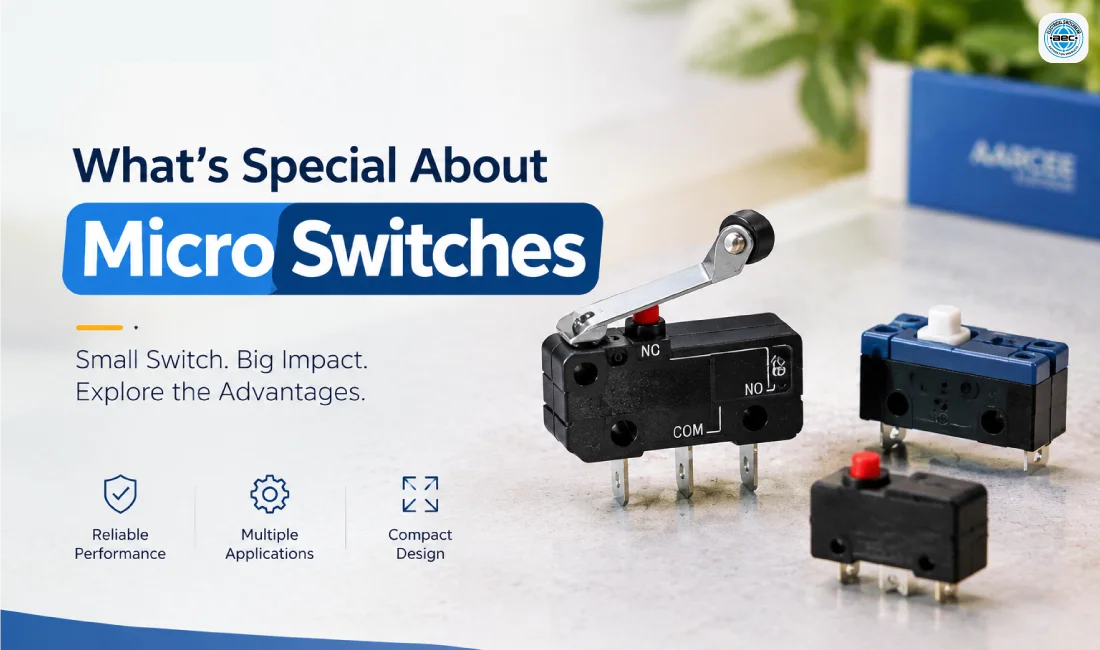
Micro Switches are small electrical components designed to control the flow of electricity through a circuit with a quick and precise switching action. Despite their compact size, they are widely used in home appliances, electronic equipment, industrial machines, control panels, safety systems, and many other applications. Their main advantage comes from the snap-action mechanism, which allows the contacts to change position quickly when the actuator reaches a specific operating point. This makes Micro Switches reliable for applications where accurate detection, repeated operation, and dependable electrical contact are important. Unlike ordinary push-button switches, Micro Switches are designed to operate with very little physical movement. They can detect the position of a moving component and immediately change the electrical state of a circuit. Depending on the design, a Micro Switch may use a pin plunger, lever, roller lever, or another actuator. The choice of actuator depends on the equipment and the amount of movement available. Their combination of compact construction, quick response, and flexible contact arrangements has made Micro Switches an important component in both electrical and electronic systems.
What Are Micro Switches and How Do They Work?
Micro Switches, also known as miniature snap-action switches, are mechanical electrical switches that use a spring-loaded mechanism to change electrical contacts rapidly. When an external force is applied to the actuator, the internal mechanism moves until it reaches a defined operating point. At that point, the spring mechanism quickly changes the position of the contacts instead of moving slowly with the actuator. This rapid switching action is one of the most important characteristics that separates Micro Switches from many conventional mechanical switches. The internal snap-action mechanism helps provide consistent switching even when the external movement is relatively small. A button, lever, or roller may move gradually, but once the operating point is reached, the electrical contacts change state quickly. This helps reduce the possibility of prolonged contact between the electrical terminals during switching. As a result, Micro Switches can provide dependable operation in equipment that requires frequent switching or position detection. Most Micro Switches are available with three main terminals: Common (C), Normally Closed (NC), and Normally Open (NO). The Common terminal acts as the main connection point, while the NC terminal is connected to the Common terminal when the switch is in its normal, unpressed condition. When the actuator is operated, the internal contacts change position and the circuit can instead connect the Common terminal to the NO terminal. This arrangement gives designers flexibility when creating control and detection circuits. The switching process begins when a force is applied to the actuator. The actuator transfers this movement to the internal spring mechanism. As the mechanism reaches its operating point, the contacts snap into their new position. When the force is removed, the spring mechanism returns the contacts to their original position. This repeated action allows the switch to detect movement, position, opening, closing, or mechanical limits in a wide range of equipment. The fast contact movement also contributes to reliable operation because the electrical transition happens quickly. However, the actual performance of a Micro Switch depends on factors such as contact material, electrical rating, operating frequency, actuator design, environmental conditions, and mechanical load. Selecting the correct specification is therefore important when installing Micro Switches in electrical or industrial equipment.
Types of Micro Switches and Their Common Applications
Micro Switches are available in several configurations to suit different mechanical and electrical requirements. One of the most common designs is the pin plunger type, where a small button or plunger is pressed directly by the moving part of a machine or device. These switches are useful where the actuator can make direct contact with the switch. Their simple construction makes them suitable for compact equipment, control mechanisms, electronic devices, and position detection applications. Roller lever Micro Switches include a small lever fitted with a roller at its end. Instead of requiring direct pressure on a small button, the moving component can pass across or press against the roller. This makes roller lever switches useful when the movement is not perfectly aligned with the switch or when smoother mechanical contact is required. They are commonly found in machinery, conveyor systems, automated equipment, and position-sensing applications. Long lever and short lever designs provide additional flexibility for equipment where the available mechanical movement differs. A longer lever can detect movement from a greater distance or from a different angle, while a shorter lever may be better suited to compact assemblies. The correct actuator design depends on the available space, required operating force, movement direction, and switching point of the application. Miniature or mouse-style switches are another compact form of Micro Switch. These are commonly used inside computer mice, control buttons, small electronic devices, gaming equipment, and other products that require frequent button activation. Although physically small, these switches can be designed for a large number of operating cycles when the correct model is selected. Micro Switches are also widely used in household appliances. Washing machines, microwave ovens, printers, vending machines, coffee machines, and other appliances may use miniature switches to detect whether a door, lid, tray, or mechanical component has reached a particular position. In these applications, the switch provides feedback to the control system so that the equipment can respond appropriately. Industrial applications can demand more robust switch designs. Micro Switches may be used for machine position detection, conveyor mechanisms, safety interlocks, control systems, and equipment monitoring. When a moving component reaches a specific position, the actuator operates the switch and changes the electrical signal. This simple method of position detection can be integrated into larger control circuits and automation systems. The wide selection of actuator styles is one reason Micro Switches remain useful across different industries. Instead of choosing a switch based only on its electrical rating, engineers and technicians must also consider how the physical movement will operate the actuator. A switch with the correct voltage and current rating may still be unsuitable if its actuator does not match the mechanical movement of the equipment.
Advantages of Micro Switches
One of the biggest advantages of Micro Switches is their compact size. They can fit into equipment where a larger conventional switch would not be practical. This is particularly useful in modern electronic products and machines where manufacturers need to save space while still providing dependable switching functionality. Their small footprint allows designers to place switching components close to the mechanism being monitored. Another important advantage is their quick snap-action operation. The internal mechanism is designed to change the electrical contact position rapidly once the operating point is reached. This provides a clear switching action and makes Micro Switches suitable for applications requiring accurate position detection. The mechanism also helps provide consistent operation over repeated cycles when the switch is used within its specified limits. Micro Switches can also offer excellent repeatability. Because the switching mechanism has a defined operating point, the electrical state changes at a predictable stage of actuator movement. This is valuable in machines and appliances where the control system needs to know whether a component has reached a particular position. Their flexible terminal configuration is another benefit. Models with Common, Normally Open, and Normally Closed contacts can be incorporated into different types of circuits. Depending on the design, a Micro Switch can be used to complete a circuit when an actuator is pressed or interrupt a circuit when a particular mechanical condition occurs. This makes the same basic switch concept useful for many different control applications. Durability is also an important feature of suitable Micro Switches. Quality switches are designed for repeated mechanical operation and can support a large number of switching cycles when operated within their specified electrical and mechanical limits. The actual service life depends on the model, load, operating environment, switching frequency, and installation conditions. Micro Switches can also provide economical solutions for position and control functions. Their small size and simple mechanical design make them practical for manufacturers and equipment builders. However, cost should not be the only selection factor. Electrical ratings, operating force, contact arrangement, actuator type, environmental protection, and expected operating cycles should all be considered before choosing a particular model.
How to Choose the Right Micro Switch
Choosing the correct Micro Switch begins with understanding the electrical requirements of the application. The voltage and current ratings should match the circuit in which the switch will operate. Using a switch outside its specified electrical limits can lead to contact damage, unreliable operation, or premature failure. Therefore, the product datasheet should always be checked before installation. The actuator type is equally important. A pin plunger is suitable when the moving component can apply direct pressure, while a roller lever may be more suitable when the movement occurs across the switch. Lever length, actuator angle, operating force, and required travel should be considered according to the mechanical design of the equipment. The contact arrangement must also match the circuit. A switch with Common, Normally Open, and Normally Closed terminals provides different wiring possibilities, but the installer must identify the correct terminals before connecting the circuit. Understanding whether the circuit should remain closed or open in the switch’s normal position helps prevent wiring errors. Environmental conditions should not be overlooked. Equipment operating in dusty, humid, oily, hot, or vibrating environments may require a Micro Switch designed for those conditions. The enclosure, sealing, contact materials, and temperature range can influence how reliably the switch performs over time. Expected operating frequency is another important consideration. A switch used occasionally in a household device may have very different requirements from one used thousands of times per day in an industrial machine. The mechanical life and electrical life specified by the manufacturer should therefore be considered before selecting the component. For reliable electrical and industrial applications, sourcing the correct component from a dependable supplier is essential. Aarcee Electrical provides a range of electrical components, including Micro Switches, for different equipment and switching requirements. You can explore the available range through the Micro Switch product category and select a model according to your application’s electrical and mechanical specifications.
Where Are Micro Switches Used?
Micro Switches are found in many everyday products because they can detect movement and position without requiring a large switching mechanism. In microwave ovens, for example, switches can be used to detect the door position. Washing machines and other appliances can similarly use switches to identify whether a lid, door, or moving component is in the required position before a particular function operates. In computers and electronic peripherals, miniature switches are commonly used for button and click detection. Computer mice are a familiar example, where small switches register individual clicks. Similar switching components can be used in keyboards, control buttons, gaming devices, printers, and other electronic products where repeated button operation is required. Industrial machinery is another major application area. Micro Switches can help detect the position of moving machine components, conveyor mechanisms, access doors, mechanical stops, and other parts. When the actuator is triggered, the switch sends a corresponding electrical signal to a control circuit, allowing the machine to respond to the detected position. They can also be incorporated into safety and interlock systems. For example, a switch may detect whether an access panel is closed before allowing a machine function to operate. The exact safety design depends on the application and applicable standards, but the basic principle demonstrates how a small mechanical switch can provide useful position feedback. Micro Switches are also useful in automation equipment, vending machines, office equipment, automotive components, control panels, and various consumer products. Their versatility comes from the combination of compact construction, different actuator options, multiple contact configurations, and quick switching action. Because applications vary significantly, there is no single Micro Switch that is ideal for every installation. The correct selection depends on the equipment’s mechanical movement, electrical load, environmental conditions, required operating life, and available installation space.
Why Micro Switches Remain Important in Modern Electrical Systems
The growing demand for compact and reliable electrical components continues to keep Micro Switches relevant across many industries. Modern machines often need to detect small mechanical movements accurately without adding large components to the overall design. A compact snap-action switch can provide this function while taking up very little space. Their simple operating principle is another reason for their continued use. A mechanical actuator can directly operate the switch, allowing it to provide a straightforward electrical signal to a larger control system. This makes Micro Switches useful in applications ranging from simple consumer products to more complex industrial equipment. The combination of small size, quick switching, flexible contact arrangements, and multiple actuator options gives Micro Switches considerable application flexibility. When the correct model is selected and installed according to its specifications, it can provide dependable service over many operating cycles. For businesses, manufacturers, technicians, and equipment designers, the most important point is to select a Micro Switch based on the actual requirements of the application rather than choosing only by physical appearance or price. Electrical ratings, actuator style, operating force, contact configuration, mechanical life, environmental conditions, and mounting requirements all contribute to long-term performance. Ultimately, Micro Switches demonstrate how a small electrical component can perform an important role in larger systems. From detecting an appliance door to monitoring industrial machinery, these miniature snap-action switches provide a practical way to control circuits and detect mechanical movement with accuracy and consistency.
Conclusion
Micro Switches may be small, but their role in electrical and electronic equipment is significant. Their snap-action mechanism, compact construction, flexible contact arrangements, and wide range of actuator designs make them suitable for applications that require dependable switching and accurate position detection. From household appliances and computer peripherals to industrial machinery and automation systems, these switches provide a simple and practical way to control circuits and detect mechanical movement. Selecting the right Micro Switch requires more than checking its size. The electrical rating, actuator configuration, operating force, contact arrangement, environmental conditions, and expected operating cycles should all match the application. With the right specification and proper installation, Micro Switches can provide consistent performance and long service life across a wide range of electrical applications.
FAQs
Have questions? We’ve answered some of the most common queries to help you understand the topic better.
Q1. What is a Micro Switch?
A Micro Switch is a compact snap-action electrical switch that changes circuit contacts when its actuator reaches a specific operating point.
Q2. What are the three terminals on a Micro Switch?
The three common terminals are Common (C), Normally Closed (NC), and Normally Open (NO).
Q3. Where are Micro Switches commonly used?
They are used in appliances, computer peripherals, industrial machinery, automation equipment, control systems, and position-sensing applications.
Q4. What is a roller lever Micro Switch?
It is a Micro Switch fitted with a lever and roller actuator, allowing moving equipment parts to operate the switch smoothly.
Q5. How do I select the right Micro Switch?
Consider the voltage, current, actuator type, operating force, contact configuration, mechanical life, environment, and available mounting space before selecting a switch.