Difference Between Under Voltage & Over Voltage Relay

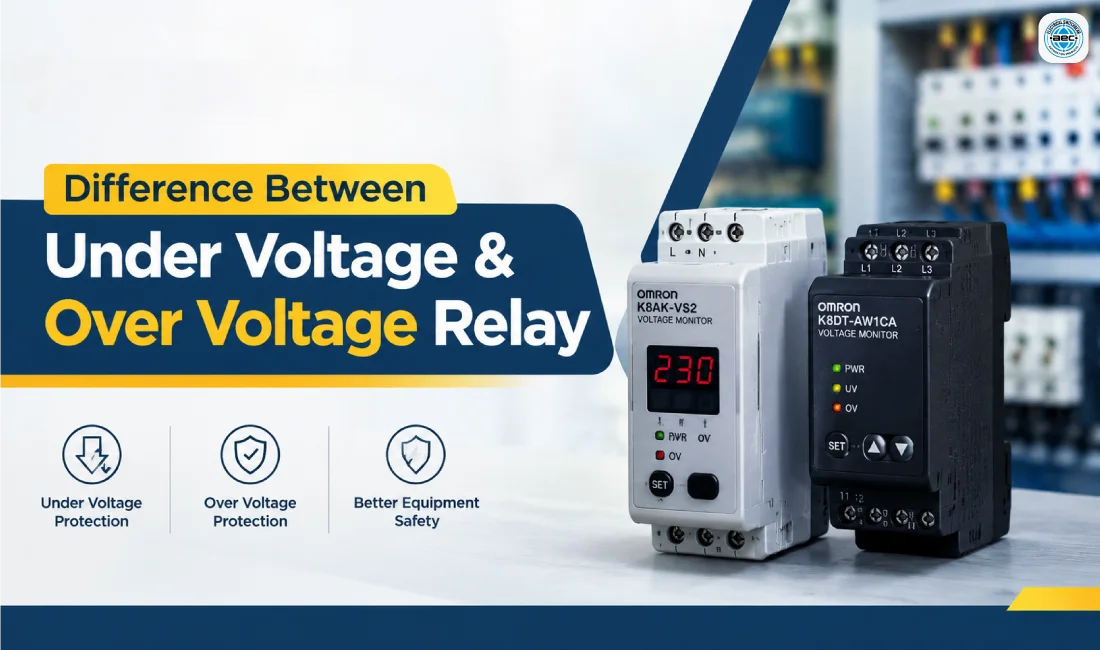
Voltage plays a major role in the safe and reliable operation of electrical equipment. Motors, control panels, automation systems, transformers, pumps, compressors, and electronic devices are all designed to operate within a specific voltage range. When the supply voltage drops too low or rises too high, equipment may not perform correctly and can experience overheating, insulation stress, malfunction, or premature failure. This is why an Under Voltage & Over Voltage Relay is an important component in many electrical protection and control systems. An under-voltage condition occurs when the supply falls below an acceptable limit, whereas an over-voltage condition occurs when the supply rises above the permitted limit. A voltage monitoring relay continuously checks the electrical supply and responds when the voltage moves outside the configured range. Depending on the application, its output can be connected to an alarm, contactor, motor control circuit, PLC, or other protective equipment. For industrial and automation applications, selecting the correct relay requires attention to the system voltage, phase configuration, protection range, time delay, and equipment requirements. Aarcee Electrical Controls provides industrial electrical, control gear, and automation products, including a dedicated Under Voltage & Over Voltage Relays category with Omron voltage monitoring products.
What Is an Under Voltage & Over Voltage Relay?
An Under Voltage & Over Voltage Relay is an electrical monitoring device designed to identify abnormal supply voltage conditions. It compares the measured voltage with predetermined limits and changes its output when the voltage moves outside the permitted range. This allows the connected control or protection system to take appropriate action instead of allowing equipment to continue operating under an unsuitable supply condition. An under-voltage function operates when the voltage falls below its lower threshold, while an over-voltage function responds when the voltage exceeds its upper threshold. Modern voltage monitoring relays can combine both functions into one unit, making them useful where both low- and high-voltage protection are required. The relay may also include adjustable thresholds and time-delay functions, depending on the model. Time delay is especially useful because electrical systems can experience short voltage fluctuations during switching, motor starting, or other temporary events. Immediate tripping for every small fluctuation could cause unnecessary interruptions. A suitable delay allows the protection system to distinguish between a temporary disturbance and a persistent abnormal voltage condition. The exact operating range and features vary between relay models. Therefore, users should always check the manufacturer’s technical specifications before selecting a device for a particular electrical panel or machine.
Difference Between Under Voltage and Over Voltage Relay
The main difference between an under-voltage and over-voltage relay is the direction of the voltage abnormality they detect. An under-voltage relay monitors for a reduction below the defined lower limit, while an over-voltage relay monitors for an increase above the defined upper limit. Both are designed to protect electrical equipment, but the potential effects of these conditions can differ. Low voltage can be particularly important for motor-driven equipment. When a motor operates at reduced voltage while carrying its normal mechanical load, it may draw increased current and generate additional heat. Prolonged operation under unsuitable conditions can contribute to insulation deterioration and motor damage. Low voltage can also affect contactors, control systems, pumps, compressors, and other electrical loads. High voltage creates a different type of concern. Excessive voltage can increase electrical stress on insulation and components and may affect sensitive electronic equipment, control circuits, transformers, and power supplies. Repeated or sustained over-voltage conditions should therefore be investigated rather than simply ignored. In power-system terminology, under-voltage protection is commonly associated with ANSI device number 27, while over-voltage protection is associated with ANSI device number 59. A modern combined voltage monitoring relay can provide both functions within the same protection arrangement.
Feature | Under-Voltage | Over-Voltage |
Trigger | Voltage falls below set limit | Voltage rises above set limit |
Main concern | Low-voltage equipment operation | Excessive electrical stress |
ANSI number | 27 | 59 |
Protection | Lower voltage threshold | Upper voltage threshold |
Possible response | Trip, alarm, or control action | Trip, alarm, or control action |
Combined monitoring | Available in many modern relays | Available in many modern relays |
The appropriate protection limits should be determined according to the equipment specifications and electrical system rather than using one fixed value for every installation.
How Does an Under Voltage & Over Voltage Relay Work?
The working principle of an Under Voltage & Over Voltage Relay is based on continuous voltage measurement. The relay receives the electrical supply through its designated sensing terminals and monitors the voltage level. During normal operation, when the measured voltage remains within the configured range, the relay maintains its normal output condition. When the voltage falls below the selected under-voltage threshold, the relay detects the abnormal condition. If the condition remains present for the configured time period, the relay changes its output state. The output can then be used to stop equipment, disconnect a load, activate an alarm, or send a signal to another control device. The same principle applies to over-voltage protection. When the supply exceeds the configured upper threshold and remains there for the required period, the relay changes its output to initiate the programmed protective response. The use of time delay can be important in practical applications. A very short voltage fluctuation may not justify stopping a machine, while a sustained abnormal voltage condition may require immediate protective action. The correct delay depends on the application, equipment characteristics, and protection requirements. Some voltage monitoring relays provide additional functions depending on their design, including phase-related monitoring and other supply-condition checks. Because features differ between models, engineers and panel builders should review the relevant datasheet before installation.
Voltage Settings and Applications of Voltage Monitoring Relays
There is no universal voltage setting that is suitable for every electrical installation. The correct threshold depends on nominal operating voltage, equipment tolerance, system characteristics, expected voltage variation, and manufacturer recommendations. As a general example, some applications may consider an under-voltage threshold around 85–90% of nominal voltage and an over-voltage threshold around 110–120%, but these values should not be treated as standard settings for every machine. For example, a 230 V single-phase system and a 415 V three-phase system have different operating requirements. The relay selected for either system must have a suitable sensing range and configuration. The equipment manufacturer’s recommended voltage range should always be considered before setting the protection thresholds. Voltage monitoring relays are commonly used in industrial control panels, motor control systems, automation equipment, pumps, compressors, HVAC systems, conveyors, manufacturing machinery, generator systems, and electrical distribution applications. They can help detect abnormal supply conditions before those conditions result in unwanted equipment operation or extended downtime. Three-phase applications require particular attention because voltage conditions can vary between phases. Depending on the relay model, additional phase-monitoring capabilities may be available. Users should therefore confirm whether the application requires single-phase voltage monitoring, three-phase voltage monitoring, or additional phase protection. Aarcee Electrical Controls’ Under Voltage & Over Voltage Relays category currently features Omron products including models from the K8AK, K8DS, and K8DT series. Customers can review the available products and their specifications according to their electrical requirements.
How to Choose the Right Under Voltage & Over Voltage Relay?
Choosing the correct Under Voltage & Over Voltage Relay starts with identifying the electrical system. First, confirm the nominal operating voltage and determine whether the application is single-phase or three-phase. Next, identify whether both under-voltage and over-voltage protection are required or whether only one monitoring function is necessary. The relay’s voltage range is another important consideration. The device must be capable of accurately monitoring the supply voltage used by the equipment. Other factors include adjustable thresholds, time delay, output contact configuration, frequency, mounting arrangement, reset behaviour, and environmental conditions. The relay should also be compatible with the overall electrical control system. For example, its output may need to operate a contactor, provide a signal to a PLC, activate an alarm, or initiate a machine shutdown sequence. Understanding this requirement before purchasing helps avoid compatibility problems during panel installation. It is equally important to remember that a voltage monitoring relay does not replace every other electrical protection device. MCBs, fuses, overload relays, surge protection devices, and other protective components perform different functions. A properly designed electrical panel may use several devices together, with each one addressing a specific electrical risk. Aarcee Electrical Controls has been supplying industrial electrical, control gear, and automation products since 2006 and serves manufacturers, OEMs, panel builders, automation integrators, contractors, and industrial businesses. Its dedicated Under Voltage & Over Voltage Relays category provides a convenient place to explore voltage monitoring products for industrial applications.
Why Choose Aarcee Electrical for Under Voltage & Over Voltage Relays?
Selecting a suitable supplier is important when purchasing industrial electrical and automation components. Product specifications, compatibility, brand authenticity, technical support, and application requirements can all affect the performance of an electrical installation. Aarcee Electrical Controls offers products across industrial electrical, control gear, and automation categories for different industrial requirements. Its dedicated Under Voltage & Over Voltage Relays product category includes Omron voltage monitoring products designed for applications where supply voltage needs to be monitored. The available range includes models such as K8AK-PM2, K8AK-PW2, K8AK-VS2, K8AK-VW2, K8DS-PH1, and K8DT-AW1CA, subject to current product availability and specifications. Before ordering, customers should confirm the required voltage, phase configuration, monitoring function, and technical specifications for their application. If you are working on an electrical panel or automation system, providing the nominal voltage and whether the system is single-phase or three-phase can help identify the appropriate type of voltage monitoring relay. You can explore Aarcee Electrical’s dedicated category for Under Voltage & Over Voltage Relays to compare the available products and select a model according to your application requirements.
Conclusion
An Under Voltage & Over Voltage Relay provides an important layer of voltage monitoring for electrical equipment and industrial control systems. Under-voltage protection detects when supply voltage drops below the selected lower limit, while over-voltage protection detects when voltage rises above the selected upper limit. Both functions help prevent equipment from continuing to operate under unsuitable electrical conditions. The correct relay depends on several factors, including nominal voltage, single-phase or three-phase operation, required protection range, time delay, output configuration, and the equipment being protected. There is no single setting or relay model that is suitable for every installation. For industrial electrical panels, automation systems, motors, pumps, machinery, and other applications, a properly selected voltage monitoring relay can work alongside other protection devices to provide a more complete protection arrangement. If you are looking for an Under Voltage & Over Voltage Relay, Aarcee Electrical Controls provides a dedicated product category featuring Omron voltage monitoring products. Review the technical specifications carefully and select the relay according to the requirements of your electrical system.
FAQs
Have questions? We’ve answered some of the most common queries to help you understand the topic better.
Q1. What is an Under Voltage & Over Voltage Relay?
It is a voltage monitoring device that detects when supply voltage falls below or rises above configured limits and provides a protective control signal.
Q2. What is the difference between under-voltage and over-voltage protection?
Under-voltage protection responds to voltage falling below a set limit, while over-voltage protection responds when voltage rises above a set limit.
Q3. Can one relay provide both protections?
Yes. Many modern voltage monitoring relays combine under-voltage and over-voltage monitoring in one device.
Q4. Are voltage settings the same for every system?
No. Settings depend on nominal voltage, equipment requirements, permissible voltage variation, and the manufacturer’s recommendations.
Q5. Where can I buy Under Voltage & Over Voltage Relays?
Aarcee Electrical Controls has a dedicated Under Voltage & Over Voltage Relays category featuring Omron voltage monitoring products for industrial applications.