Common Applications of Control Relays

Introduction to Control Relays
Control Relays are essential electrical switching components used in a wide range of industrial, commercial, automation, and electrical control applications. They allow a relatively low-power control signal to operate another electrical circuit without requiring the control device to handle the full load directly. This makes them particularly useful in control panels where PLCs, push buttons, sensors, timers, switches, and other control devices need to operate motors, contactors, solenoid valves, lighting circuits, fans, pumps, alarms, and other electrical equipment. By separating the control circuit from the controlled circuit, Control Relays can improve flexibility, simplify wiring, and provide useful electrical isolation between different parts of a system. The applications of Control Relays have expanded significantly with the growth of industrial automation and modern electrical control systems. Manufacturing plants use them for machine sequencing, motor control, process automation, and signal interfacing, while commercial buildings use relay-based control for HVAC equipment, lighting, pumps, and other building services. They are also found in power distribution panels, equipment control systems, automotive electrical circuits, and various appliances. Their simple operating principle, availability in different contact configurations, and compatibility with different control voltages make them practical for both basic and complex electrical applications. For businesses, manufacturers, OEMs, automation integrators, and maintenance teams, selecting the correct relay is important because every application has different electrical requirements. Factors such as coil voltage, contact rating, load characteristics, switching frequency, operating environment, mounting arrangement, and required contact configuration can influence relay performance. A properly selected relay can support reliable equipment operation, while an incorrectly specified relay may experience contact damage, overheating, premature failure, or unreliable switching. This is why Control Relays should always be selected according to the complete electrical application rather than simply choosing a relay based on physical size or current rating. Aarcee Electrical Controls is a reliable source for industrial electrical, control gear, and automation products, supporting customers across manufacturing, OEM, automation integration, and infrastructure applications. The company offers a broad range of electrical and control products designed to meet the practical requirements of industrial electrical systems. Businesses looking for dependable electrical components can explore the available range through Aarcee Electrical Controls and identify products suitable for their control panel, automation, and industrial requirements. As electrical systems become increasingly automated, Control Relays continue to provide an important connection between electronic control systems and physical electrical equipment. Even when modern PLCs, sensors, HMIs, drives, and communication systems are used, relay interfaces remain valuable for switching, isolation, signal conversion, interlocking, and auxiliary control functions. Their continued use demonstrates that simple electrical components can still play an important role in sophisticated automation systems when they are correctly selected and integrated.
What Are Control Relays and How Do They Work?
Control Relays are electrically operated switching devices designed to allow one circuit to control another circuit. In a typical relay, an electrical signal is applied to a coil, which produces a magnetic field that operates an internal switching mechanism. This mechanism changes the state of the relay contacts, allowing the connected circuit to be opened, closed, or redirected depending on the relay’s contact arrangement. The control circuit and the switched circuit can therefore perform different functions, which is particularly useful when a low-power controller needs to operate equipment that requires a different voltage or higher switching capacity. The basic components of a relay include the coil and contacts, although the exact construction varies depending on the relay type. When the coil receives its specified control voltage, the relay changes from its normal state to its energized state. Normally Open (NO) contacts close when the relay is energized, while Normally Closed (NC) contacts open when the relay operates. Changeover arrangements can provide both switching functions within the same device. These contact configurations allow engineers to create different control sequences, interlocking arrangements, alarm circuits, and equipment operating conditions according to the requirements of the application. One of the most important advantages of Control Relays is the ability to separate the control signal from the load circuit. For example, a PLC output may provide a 24V DC signal, while the circuit being controlled may require a different voltage or switching arrangement. Instead of connecting the PLC output directly to the external load, a suitable relay can act as an interface between the PLC and the equipment. This arrangement can help protect sensitive control electronics from unsuitable electrical conditions and provide greater flexibility when different parts of an electrical system operate at different voltage levels. Control Relays can also be used to create electrical logic and interlocking functions. In industrial machinery, several relay contacts can work together with push buttons, sensors, contactors, timers, and protection devices to ensure that equipment operates in the required sequence. For example, an interlocking circuit can prevent two conflicting commands from being activated simultaneously. Similarly, an auxiliary relay can provide a signal to another part of the control system when a particular machine condition occurs. These functions make relays useful for both straightforward switching applications and more structured industrial control systems. The control voltage of a relay is another important consideration. Depending on the application, relays may be designed for different AC or DC coil voltages, including commonly used industrial control voltages. The selected coil voltage must correspond to the actual control circuit because applying an unsuitable voltage can result in unreliable operation or component damage. At the same time, the relay contacts must be selected according to the voltage and current characteristics of the circuit being switched. The coil rating and contact rating therefore need to be evaluated separately when selecting Control Relays. Load characteristics are equally important because not every electrical load behaves in the same way when switched. Resistive loads such as some heating elements have different switching requirements from inductive loads such as motors, contactors, solenoid valves, and transformers. Motors and other inductive devices can create starting or inrush currents that place additional stress on relay contacts. Electronic equipment may also have its own switching characteristics. Therefore, the relay’s published ratings should be checked against the actual application, including operating voltage, current, load type, switching frequency, and expected service conditions.
Common Applications of Control Relays
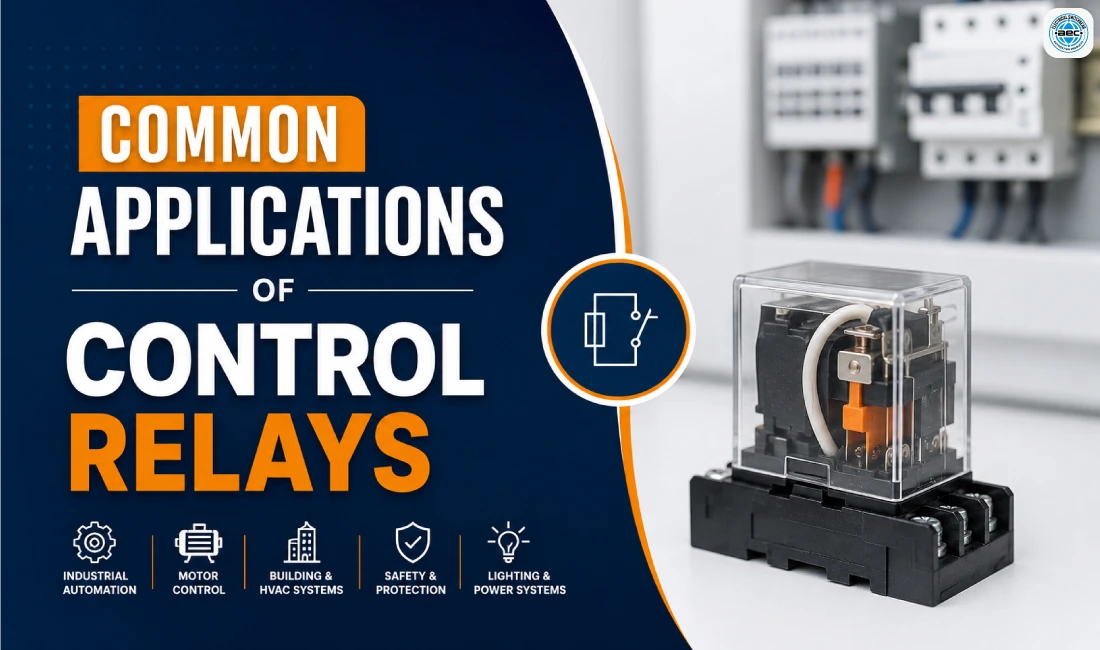
Control Relays are widely used in industrial automation because automated equipment often needs multiple electrical signals to operate motors, valves, sensors, indicators, actuators, and auxiliary devices in a coordinated manner. In manufacturing environments, relays can be used between PLC outputs and field equipment, allowing control signals to operate devices while maintaining an appropriate interface between the controller and external circuits. They can also support machine start-stop functions, alarm circuits, sequence control, equipment status indication, and electrical interlocking. Conveyor systems, packaging machines, assembly equipment, material-handling systems, and production machinery can all incorporate relay-based control circuits depending on their design. Motor control is another important application of Control Relays. Motors used in pumps, conveyors, fans, compressors, machine tools, and production equipment often require control circuits that coordinate commands from switches, sensors, PLCs, timers, and protection devices. A relay may operate the control circuit of a contactor or provide an auxiliary switching function rather than directly carrying the motor’s main power current. In forward-reverse motor applications, appropriate interlocking arrangements can help prevent incompatible commands from being activated at the same time. The complete motor control system should also include suitable overload and short-circuit protection because a Control Relay is not a substitute for dedicated motor protection equipment. PLC control panels frequently use Control Relays as interface components between electronic controllers and external equipment. A PLC may generate a relatively small output signal, while the connected field device may require different electrical characteristics. A relay interface can help provide signal isolation, contact conversion, or additional switching flexibility. This is particularly useful when a control panel contains equipment operating at different voltage levels or when a PLC output needs to operate a contactor, solenoid valve, indicator, alarm, or auxiliary circuit. Proper relay selection can also make panel wiring easier to organize and simplify maintenance when individual control functions need to be tested. Power distribution and electrical control panels also make use of Control Relays for switching, monitoring, indication, and interlocking functions. Depending on the system design, relays can respond to signals from monitoring or protection equipment and initiate a predefined control action. They may also be used to control auxiliary circuits associated with electrical distribution equipment. In three-phase systems, monitoring arrangements can detect conditions such as phase sequence or phase loss and provide a control signal when an abnormal condition is identified. Dedicated protective devices should always be used where required, while the relay performs the control or interface function assigned to it. HVAC and building automation systems provide another practical application for Control Relays. Heating equipment, ventilation fans, air-conditioning systems, compressors, pumps, exhaust systems, and other building services may need to respond to signals from thermostats, controllers, sensors, timers, or building management systems. A relay can allow the control device to operate an appropriately rated electrical circuit without carrying the entire load current itself. In larger buildings, several relay-controlled circuits may work together to manage equipment according to temperature, occupancy, schedules, or other operating conditions, helping create a more organized and automated building control system. Lighting control panels can also use Control Relays to operate groups of lighting fixtures from a central control system. This is particularly useful in factories, warehouses, offices, commercial buildings, and large facilities where numerous lighting circuits need to be switched according to schedules, sensors, switches, or automation commands. A relay can provide an interface between the lighting control system and the electrical supply circuit. When selecting a relay for lighting applications, engineers should consider the actual characteristics of the lighting load, including the inrush behavior of electronic LED drivers and other equipment, rather than relying only on the nominal operating current. Pump and water-level control systems commonly use relay-based switching arrangements to automate equipment according to signals from float switches, level sensors, pressure switches, or dedicated controllers. For example, a level-control system can send a signal when a water tank reaches a particular level, causing a relay to operate the control circuit of a pump. The pump can then be started or stopped according to the designed control logic. Similar arrangements can be used for drainage, water supply, cooling systems, industrial process water, and other fluid-handling applications. Proper motor protection and control equipment should be included because the relay’s role is generally to provide the required control function rather than to replace the pump’s protection system. Safety interlocking and machine-control circuits can also incorporate relays where the application and required safety architecture permit their use. A relay can help ensure that one operation cannot take place while another conflicting condition exists. For example, a machine may use electrical interlocking to prevent two opposing contactors from being energized simultaneously. Relays can also transmit fault, reset, or emergency-related control signals to other parts of a system. However, general-purpose Control Relays should not automatically be treated as safety relays. Where a machine requires a certified safety function, appropriately rated safety components and a properly engineered safety circuit should be used. Control Relays are also found in automotive electrical systems and appliances where a low-current switch or controller needs to operate a higher-current electrical load. Vehicle systems may use relays for applications involving headlights, horns, fans, wipers, pumps, and other equipment, while appliances can use relay-based circuits to control internal electrical loads. The exact relay design differs according to the application, but the fundamental principle remains similar: a control signal operates contacts that switch another circuit. Environmental factors such as vibration, temperature, moisture, available space, and electrical transients can become particularly important in automotive applications and should be considered during component selection. Across all these applications, the key purpose of Control Relays is to provide a dependable switching or interface function that connects control logic with electrical equipment. Their versatility allows the same basic technology to be adapted for industrial machinery, automation panels, building services, power systems, pumps, lighting, vehicles, and many other applications. For this reason, understanding the electrical requirements of the application is more important than simply choosing a relay based on its name or appearance. A suitable relay should be selected only after evaluating the control voltage, contact requirements, load characteristics, operating environment, switching frequency, and overall circuit design.
Benefits of Using Control Relays
Control Relays offer several practical advantages in electrical control systems, which is why they continue to be widely used in industrial automation, machinery, power distribution, HVAC systems, lighting panels, and commercial equipment. One of their biggest advantages is that they allow a control circuit to operate another circuit without directly carrying the full load, making it easier to connect controllers with electrical equipment. This separation can provide useful electrical isolation and help protect sensitive control devices from conditions present in the switched circuit. Control Relays can also simplify complex control arrangements by allowing individual switching functions to be organized into manageable circuits. When correctly selected and installed, they can contribute to dependable operation, easier troubleshooting, and greater flexibility in electrical control panel design. Another major benefit is their ability to interface different parts of an electrical system. Modern control panels may contain PLCs, sensors, HMIs, timers, contactors, motor starters, drives, solenoid valves, indicators, and protection devices, and these components do not necessarily operate at the same voltage or use the same type of output signal. A suitable relay can act as an interface between these devices, allowing a control signal to operate a circuit with different electrical requirements. This is particularly useful in automation applications where a PLC output needs to control an external device while maintaining an appropriate level of separation between electronic control equipment and field circuits. Control Relays also provide flexibility through different contact arrangements. Depending on the application, normally open, normally closed, and changeover contacts can be used to create different control conditions. This makes relays suitable for start-stop circuits, alarm indication, interlocking, signal conversion, equipment status feedback, and sequencing operations. Multiple relay contacts can also be incorporated into a larger control circuit so that one electrical event can trigger several related actions. This flexibility is valuable when designing control panels that must respond to several operating conditions or when a machine requires a defined sequence of operations. Reliability is another important reason for using Control Relays in industrial electrical applications. A properly rated relay can perform repeated switching operations over an extended period when it is used within its specified electrical and environmental limits. However, reliability depends heavily on correct component selection. Contact ratings, coil voltage, load characteristics, switching frequency, ambient temperature, mechanical vibration, and installation conditions all affect service life. Using a relay outside its recommended limits can cause contact welding, excessive arcing, overheating, or premature failure. For this reason, a relay should always be selected according to the actual circuit rather than relying only on its nominal current rating. Control Relays can also make electrical systems easier to troubleshoot and maintain. Because individual control functions can be separated into relay circuits, technicians can often identify whether a problem originates from the control signal, relay coil, contacts, wiring, or connected equipment. Visual indicators available on some relay products can further assist maintenance personnel by showing the operating state of the relay. Clear panel labeling and proper wiring practices can make this benefit even greater. In industrial environments where equipment downtime can affect production, straightforward troubleshooting can help maintenance teams identify electrical problems more efficiently and restore equipment operation. Another advantage is the relatively straightforward integration of relay circuits into existing equipment. Industrial plants frequently contain machines of different generations, and not every system is built around the same control technology. Control Relays can provide a practical interface between older relay-based equipment and newer automation systems. They can also be useful when modifying an existing control panel because an additional relay may allow a new signal or device to be incorporated without redesigning the entire control architecture. This makes relay technology useful not only for new installations but also for machine upgrades, maintenance projects, and automation retrofits. For organizations purchasing electrical and automation components, product availability and technical support can be just as important as the component’s electrical specifications. Aarcee Electrical Controls serves industrial customers with electrical, control gear, and automation products for applications involving manufacturing units, OEMs, automation integrators, and infrastructure projects. Businesses can explore the available product range through Aarcee Electrical Controls when sourcing components for electrical panels, machine controls, industrial automation, and related applications.
How to Select the Right Control Relay
Selecting the correct Control Relays requires a clear understanding of the electrical circuit, the equipment being controlled, and the conditions under which the relay will operate. The first specification to check is the coil or control voltage because the relay coil must be compatible with the signal provided by the control system. Common industrial control circuits may use DC or AC control voltages, but the correct value depends entirely on the equipment design. A relay intended for one coil voltage should not be assumed to work correctly with another voltage. Before purchasing, always compare the relay coil specification with the actual output voltage from the PLC, controller, switch, sensor, or other control device. The next consideration is the contact rating. The relay contacts must be capable of safely switching the voltage and current required by the connected circuit. However, simply comparing the nominal current of the load with the relay’s printed current rating may not be sufficient. Different load types behave differently during switching. Resistive loads may have relatively predictable current characteristics, while motors, solenoids, transformers, contactor coils, compressors, and other inductive loads can produce high inrush or switching transients. Electronic equipment may also have unique input characteristics. Therefore, engineers should consult the manufacturer’s specifications and ensure that the relay is suitable for the actual load category. Contact configuration is another important selection factor. Normally Open contacts are commonly used when a circuit should remain disconnected until the relay is energized, while Normally Closed contacts are useful when a circuit should remain connected until the relay operates. Changeover contacts provide additional flexibility by allowing one common connection to switch between two contact states. The number of poles and required contact sets should also be considered when the relay needs to control more than one circuit. Choosing the appropriate configuration can reduce unnecessary wiring and help the control panel perform the intended sequence correctly. Switching frequency and expected operating life should also be evaluated, particularly in automation systems where a relay may operate thousands or millions of times during its service life. A relay used for occasional switching may have very different requirements from one used continuously in a high-speed machine. Frequent switching can increase contact wear and may reduce the service life if the relay is not designed for the application. The type of load, switching current, operating frequency, and electrical suppression arrangements can all influence contact life. When designing an automated system, the expected switching cycle should therefore be considered before finalizing the relay specification. The physical installation environment is another factor that should not be overlooked. Control panels may be installed in factories, warehouses, machine rooms, outdoor equipment areas, or locations where dust, moisture, vibration, heat, or chemical exposure can affect electrical components. A relay suitable for a clean indoor control cabinet may not necessarily be appropriate for a harsh industrial environment. Panel temperature, ventilation, mounting method, available space, terminal arrangement, and enclosure requirements should all be evaluated. Proper installation can help maintain reliable operation and reduce the likelihood of premature component deterioration. Compatibility with the rest of the automation system is equally important. If the relay is being used with a PLC, sensor, controller, contactor, timer, or protection device, its coil and contact characteristics should match the equipment connected to it. For PLC applications, engineers should confirm that the PLC output can supply the relay coil requirements and that the relay contacts can safely switch the intended field device. In some cases, a dedicated interface relay may be preferable because it provides the required isolation or signal conversion. Reviewing manufacturer datasheets before installation can prevent compatibility problems and unnecessary component replacement. A reliable electrical component supplier can also simplify the selection process by helping customers identify products according to their actual application requirements. Aarcee Electrical Controls provides industrial electrical, control gear, and automation products and works with customers across manufacturing, OEM, automation integration, and infrastructure applications. If you are planning a control panel or automation project, you can visit Aarcee Electrical Controls to explore its industrial product range and identify components suited to your requirements.
Common Problems, Maintenance and Safety Considerations
Although Control Relays are designed for reliable electrical switching, incorrect selection, unsuitable operating conditions, poor wiring, and excessive electrical stress can lead to problems. One common issue is contact wear, which can occur when relay contacts repeatedly switch loads that generate high inrush current or electrical arcing. Over time, damaged contacts may develop increased resistance, fail to make proper electrical contact, or become welded together. This can result in intermittent operation, unexpected equipment behavior, or complete circuit failure. Selecting a relay according to the actual load characteristics and switching requirements is one of the most important ways to reduce this type of problem. Coil-related problems can also affect relay performance. If the coil receives an incorrect voltage, the relay may fail to operate correctly or may suffer damage. Low or unstable control voltage can cause unreliable switching, while excessive voltage can create overheating and shorten component life. Loose wiring at the coil terminals can create intermittent operation and make fault diagnosis difficult. During maintenance, technicians should inspect the control voltage, terminal connections, wiring condition, and relay operating state rather than replacing the relay immediately without identifying the underlying cause. Overheating is another condition that should be monitored, particularly in densely packed electrical control panels. Excessive temperature can result from high ambient temperatures, poor ventilation, overloaded contacts, incorrect relay selection, or excessive switching activity. Heat can affect both the relay and nearby components, potentially reducing the service life of the overall control panel. Maintaining suitable panel ventilation, avoiding unnecessary heat accumulation, and following the manufacturer’s installation requirements can help reduce thermal stress. Inductive loads require particular attention because they can generate electrical transients when their current is interrupted. Motors, solenoid valves, contactor coils, and similar loads may cause arcing at relay contacts if appropriate suppression is not provided. Depending on the circuit design, suitable suppression methods may be used to reduce switching transients and contact stress. The correct solution depends on whether the controlled circuit is AC or DC and on the characteristics of the connected load. Electrical designers should therefore follow the equipment manufacturer’s recommendations rather than applying a generic suppression method to every relay circuit. Routine inspection can help identify potential problems before they result in equipment downtime. Maintenance personnel can check relay operation, terminal tightness, visible signs of overheating, discoloration, unusual noise, damaged wiring, and abnormal switching behavior. Where control panels are used in demanding industrial environments, inspection intervals should be based on operating conditions, equipment criticality, manufacturer recommendations, and maintenance procedures. Components showing signs of damage should be investigated and replaced with correctly specified products rather than simply bypassing the relay or installing an unsuitable substitute. Safety is especially important when working with relay-controlled electrical systems because the relay itself may be connected to circuits carrying hazardous voltage or significant electrical current. Power should be isolated according to the site’s approved electrical safety procedures before maintenance work is performed. Technicians should use appropriate personal protective equipment, test for the absence of voltage where required, and follow applicable electrical standards and workplace procedures. Control Relays should never be treated as a substitute for circuit breakers, fuses, overload protection, emergency isolation, or dedicated safety components where those devices are required. It is also important to understand the difference between a general-purpose Control Relay and a dedicated safety relay. A standard relay can perform many switching and interlocking functions, but that does not automatically make it suitable for a safety-related application. Machinery requiring personnel protection may need certified safety relays, safety controllers, monitored contacts, redundant circuits, and other safety-rated components. The required architecture should be determined through an appropriate risk assessment and engineering process. Using an ordinary relay in a safety-critical circuit without verifying its suitability can create serious risks. Good documentation and correct labeling are additional parts of relay maintenance. Control panels should have clear circuit identification so technicians can understand which relay performs which function. Wiring diagrams should correspond to the installed equipment, and changes made during machine modifications should be documented. This can significantly reduce troubleshooting time and help maintenance teams avoid accidental changes to unrelated circuits. Proper records also make future replacement easier because technicians can identify the required coil voltage, contact configuration, and other specifications.
Why Choose Aarcee Electrical Controls for Control and Automation Components?
Choosing the right source for Control Relays and related industrial electrical products can have a direct impact on project reliability, maintenance efficiency, and component availability. Aarcee Electrical Controls focuses on industrial electrical, control gear, and automation products and serves customers including manufacturing units, OEMs, automation integrators, and infrastructure projects. The company has been operating since 2006 and is based in Kundli, Sonipat, Haryana, supporting industrial requirements with a broad selection of electrical and automation products. Aarcee Electrical Controls maintains a product portfolio covering several important categories used in industrial electrical and automation applications. Its range includes control and switching products, electrical protection equipment, automation components, industrial accessories, push buttons, indicators, and other products used in electrical control systems. This makes the company relevant not only for customers looking for individual components but also for businesses sourcing multiple products for control panels, machine-building projects, maintenance requirements, and industrial installations. Product quality and brand selection are important considerations when sourcing electrical control components. Aarcee Electrical Controls works with established manufacturers and brands across the electrical and automation sector, helping customers access products intended for professional industrial applications. When selecting Control Relays, customers should still verify the exact technical specifications required for their application, including coil voltage, contact rating, contact configuration, load type, mounting requirements, and environmental conditions. A supplier with experience in industrial applications can also help customers avoid common purchasing mistakes. For example, a relay may appear suitable based on its current rating but may not be appropriate for a motor, solenoid, compressor, or other inductive load. Similarly, a relay with the correct contacts may have the wrong coil voltage for a PLC output. Discussing the application requirements before purchasing can help identify these issues and ensure that the selected component is compatible with the complete control circuit. Aarcee Electrical Controls is particularly relevant for businesses that need industrial electrical and automation components for manufacturing plants, machine panels, OEM equipment, automation projects, and infrastructure applications. Customers can visit Aarcee Electrical Controls to explore the company’s product categories and learn more about available electrical and control solutions. For project-specific requirements, sharing the load type, control voltage, application, and required switching function can make the product selection process more precise. For industrial customers, dependable component sourcing is not only about purchasing a single product; it is about ensuring that the selected electrical components fit the overall system and can support the intended operating conditions. By considering the application, technical specifications, brand requirements, and installation environment together, businesses can make more informed purchasing decisions. Control Relays are relatively small components, but their role in the overall electrical control system can be significant, making correct selection and reliable sourcing important for long-term equipment performance.
Conclusion
Control Relays continue to be an important part of electrical control and industrial automation because they provide a practical way to connect control signals with electrical equipment while supporting switching, isolation, interlocking, and signal interface functions. Their applications range from PLC control panels and motor systems to HVAC equipment, lighting circuits, pumps, power distribution, machinery, automotive systems, and many other electrical installations. Although relay technology is relatively simple, reliable performance depends on selecting the correct coil voltage, contact rating, contact arrangement, load category, switching frequency, and environmental specification for the intended application. The growing use of automation has not reduced the importance of Control Relays; instead, relays continue to complement PLCs, sensors, controllers, contactors, drives, and other modern automation technologies. They can provide an effective interface between electronic control systems and electrical loads, especially when different circuits require separation or when additional switching flexibility is needed. Proper installation, maintenance, documentation, and electrical safety practices are equally important for achieving dependable long-term operation. For businesses searching for industrial electrical, control gear, and automation products, Aarcee Electrical Controls offers a broad product portfolio serving manufacturing, OEM, automation integration, and infrastructure requirements. If you are planning a new control panel, upgrading existing machinery, replacing electrical components, or sourcing automation products, visit Aarcee Electrical Controls to explore the available solutions and select products according to your project requirements. Ultimately, the right Control Relay is not simply the one that fits the panel or carries a particular current rating. It is the component that matches the control voltage, load characteristics, switching requirements, environmental conditions, and overall system design. Taking the time to evaluate these factors can improve reliability, reduce avoidable component failures, and help electrical and automation systems operate safely and efficiently.
FAQs
Have questions? We’ve answered some of the most common queries to help you understand the topic better.
Q1. What are Control Relays used for?
Control Relays are used to switch and control electrical circuits using a separate control signal. They are commonly used in automation, motor control, PLC panels, HVAC, lighting, and power systems.
Q2. How do Control Relays work?
A control signal energizes the relay coil, which changes the position of its internal contacts. This allows another electrical circuit to be switched ON, OFF, or redirected.
Q3. Can Control Relays be used with PLCs?
Yes. Control Relays are frequently used between PLC outputs and external devices to provide switching capability, signal conversion, and electrical isolation.
Q4. How do I select the right Control Relay?
Check the coil voltage, contact rating, load type, contact configuration, switching frequency, and operating environment before selecting a relay.
Q5. Where are Control Relays commonly used?
They are widely used in industrial automation, motor control panels, HVAC systems, lighting systems, pumps, power distribution, machinery, and electrical equipment.